Sometimes we’ll experience what feels like a tender area high on the shoulders. This can, and sometimes does, radiate pain to the head too. Often, this is a trigger point. Unlike other types of massage, where the therapist will apply generalized pressure, trigger point massage centers in on the areas within a muscle that are tender and oversensitive. Below, we discuss trigger points, explore how a therapist will locate and treat them, and tell you what to expect. We look at the evidence and share when it is advisable to consult a health professional rather than receive a massage.
What Is Trigger Point Massage?
Trigger point therapy, or trigger point massage, is when a therapist applies steady pressure to a tender area within a muscle. As stated by Cleveland Clinic, the therapy also incorporates methods of myofascial release to treat fascia (the connective tissue that surrounds the muscles) that contains a localized area of firmness.
Within a spa, this can be referred to as trigger point massage therapy, trigger point therapy massage, and “knot work.” All involve the same principle. While the therapist is treating you, they will identify the areas that are tender and restricted. Then they will both continue to apply pressure and use wider, more general massage movements to encourage relaxation of the muscle.
While it is a type of therapy, trigger point massage is also often included as part of a number of massage treatments. This will depend on where your body is experiencing tension and can therefore be part of a neck and shoulder massage, back massage, and even a full body massage. It is also heavily used within massage for muscle knots.
What Is a Trigger Point?
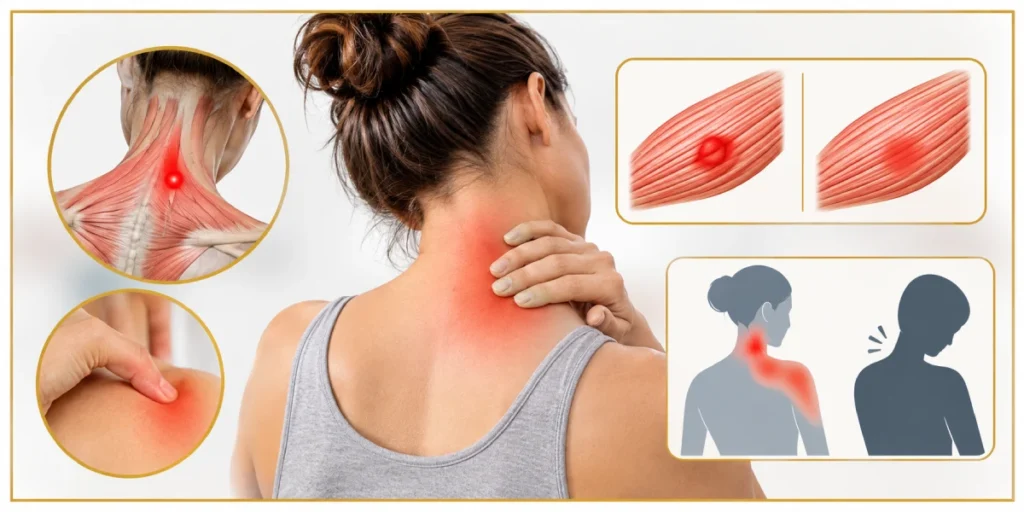
The simplest trigger point definition is an oversensitive area within a tense band of muscle. As identified by StatPearls, trigger points can cause pain in the area where they are located and also cause referred pain. Trigger points are also very prevalent.
In addition, a further review on StatPearls states that the majority of people will experience a trigger point in their lifetime.
According to the American Massage Therapy Association, muscle trigger points can arise as a result of acute, chronic, and/or repetitive overuse. For example, this can result from sitting slouched over a computer all day, carrying a heavy bag consistently on one side, and/or undertaking slightly excessive exercise.
Active vs. Latent Trigger Points
Not all trigger points are obvious. StatPearls classifies them as either active or latent:
- Active trigger points cause pain by themselves and/or on movement.
- Latent trigger points are unobtrusive until a therapist applies pressure to them.
Often, it is these latent trigger points that are then identified during a massage. Until the therapist treats a particular area, you may not even recognize that you have a trigger point there. You will then commonly experience that familiar “there we go” type of pain.
What Does a Trigger Point Feel Like?
Typically, a trigger spot will be a firm lump or cord-like structure within a muscle. It has been likened by Cleveland Clinic to a small marble. It is tender to the touch and can radiate pain outward by a few inches. Sometimes the pain is even felt in an unexpected place. In addition, the area may become inflexible and lose some range of motion, so, for example, you may struggle to turn your head fully to one side.
How Does Trigger Point Massage Work?
Fundamentally, this is about applying pressure to a tender area and doing so for sufficient time to elicit a muscle response. Researchers refer to this as “ischemic compression.” Typically, pressure is applied for 30, 60, or 90 seconds at a time to a trigger point (as outlined within a 2022 meta-analysis).
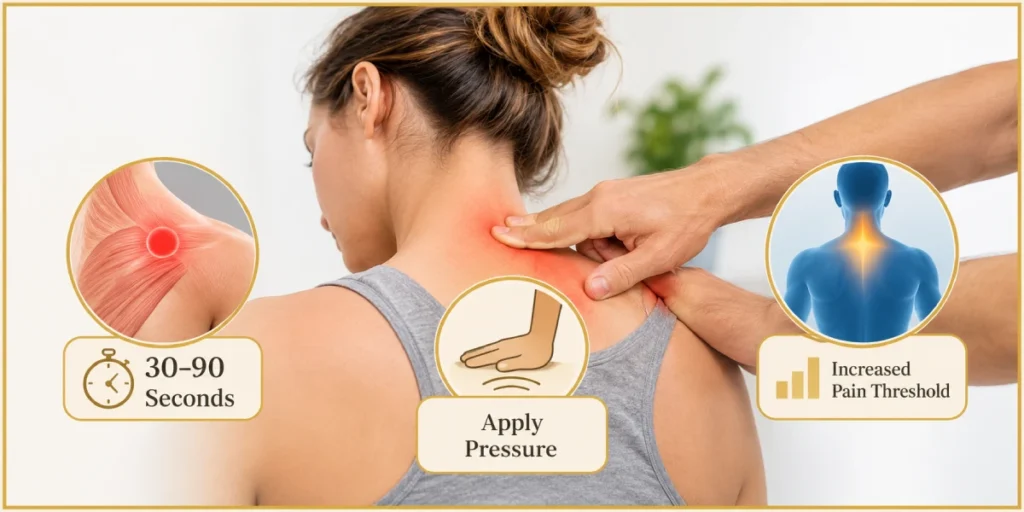
While the precise process is still debated, research has shown that massage can increase an individual’s pressure pain threshold. Within a randomized controlled trial investigating adults who suffer from tension-type headaches, massage was used to facilitate trigger point release within the upper trapezius and suboccipital (base of skull) muscles. Those individuals demonstrated an increased pain threshold. Neither the sham nor the waitlist group experienced this.
While there is evidence that ischemic compression can improve an individual’s pain threshold, a 2022 meta-analysis indicated that there was no significantly reduced pain score immediately after this type of treatment in comparison to control groups. Therefore, although effective, trigger point treatment is most beneficial as just one method for addressing muscular tension.
What Does Trigger Point Massage Feel Like?
Trigger point massage can feel quite firm, particularly when the therapist first applies pressure to a tender area. It is normal to experience a deep aching sensation as pressure is applied to a trigger point. Often, this ache will gradually ease as the muscle begins to relax.
You may also notice the discomfort spreading slightly to a nearby area, which is known as referred pain. However, you should not feel any sharp, stinging, or “electric” sensations. If you do, please inform your therapist so that they can alter the pressure or move on. Throughout the massage, you remain in charge.
Where Are Common Trigger Points Found?
Body trigger points can develop within almost any bone-attached (skeletal) muscle. However, there are common locations, often associated with muscles that we rely upon throughout the day for postural support.
Within the table below are examples of common trigger point areas, the muscles commonly affected, and areas where the pain may be felt.
| Location | Commonly affected muscles | Areas of pain |
|---|---|---|
| Neck and top of the shoulders | Upper trapezius | Side of the neck and possibly also temple |
| Base of the skull | Suboccipital muscles | Back of the head |
| Shoulder blade | Infraspinatus | Front of shoulder and arm |
| Upper back | Rhomboids and levator scapulae | Between shoulder blades and junction of neck and shoulders |
| Lower back | Quadratus lumborum | Low back and hip |
| Hips | Gluteal muscles | Buttock and outer hip |
(This table shows common patterns only and should not be used for self-diagnosis. Your pain may have more than one cause, so speak with a healthcare professional if you are unsure.)
The “temple” trigger point is commonly seen to arise as a result of upper trapezius trigger points and is identified within headache research. Typically, infraspinatus trigger points refer pain to the front of the shoulder and arm (StatPearls).
Trigger Point Massage vs. Massage for General Muscle Tension
A general muscle tension massage involves wider sweeping movements that warm up the muscles and enable the body to relax. Trigger point massage is more focused. The therapist will spend more time applying pressure to selected areas. While neither is superior, in reality, a good massage will often combine both.
First, general massage is used to warm up the muscles. Next, the therapist will concentrate on the specified area(s) and apply pressure. Finally, lighter massage movements complete the treatment. For basic information regarding how deep tissue massage is performed, please refer to our guide on what deep tissue massage is.
Trigger Point Release Techniques a Therapist May Use
Although therapists will each have their own methods, generally there are some common trigger point release techniques. These include:
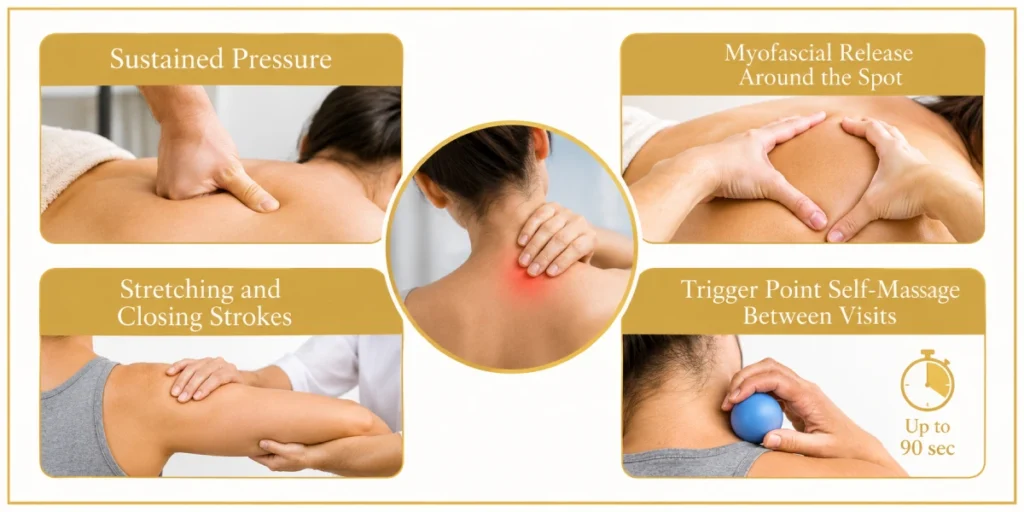
Sustained Pressure
Using a thumb, knuckle, and/or elbow, the therapist will apply pressure. As pressure is applied, the area should begin to relax slightly. The AMTA highlights that therapists will maintain pressure on a trigger point until they perceive a change within the muscle. At this stage, they will switch to general massage. Importantly, they will avoid applying excessive pressure.
Myofascial Release Around the Spot
Myofascial release involves gently stretching the skin and fascia surrounding a trigger point. This is a less invasive method than pressure application, and it enables the area to release. This can then help prevent re-constriction. Sometimes, therapists will utilize both pressure application and myofascial release, an approach known as trigger point myofascial therapy.
Stretching and Closing Strokes
Following trigger point release, light stretching and then gentle sweeping massage movements are used to further encourage muscle relaxation. Stretching is also highlighted by the AMTA as a method to help maintain the benefits of a massage.
Trigger Point Self-Massage Between Visits
Mild trigger point self-massage can be carried out at home. Cleveland Clinic suggests applying firm yet comfortable pressure using fingers or a massage ball to a trigger point for up to 90 seconds. Should the pain increase, stop applying pressure. Ensure that you don’t apply pressure to the front and/or side of your neck too vigorously, and avoid direct pressure on your spine.
What Happens During a Trigger Point Massage Session?
At Serenity Head Spa, trigger point and knot release is included within our Neck and Shoulder Massage, which usually lasts 30 to 60 minutes. Generally, a therapist will:
- Take brief initial information regarding your areas of concern and desired level of massage pressure.
- Carry out warm-up movements on your upper back and shoulders.
- Apply pressure to address knots and restricted areas.
- Perform detailed massage of the neck and shoulder muscles.
- Undertake light stretching movements and concluding light massage movements.
Should your main areas of tension be toward the lower part of your body, our Back Massage will focus more deeply on your back. Moreover, within a Full Body Massage, your therapist will have the opportunity to address a number of areas.
It is common to experience some degree of soreness for a day or so post-treatment. Please see our page discussing whether it is normal to feel sore following a massage for further information and advice on how to alleviate such discomfort.
When Should You Talk to a Healthcare Professional Instead?
As previously mentioned, massage is used to address general muscular tension. However, it is not a diagnostic tool. Cleveland Clinic suggests that you should consult a health professional if you experience severe pain, a sharp pinching sensation, or tingling, as these can indicate an issue that is not purely musculoskeletal in origin. Likewise, it recommends that you seek medical advice if your pain continues for more than a few days or weeks.
Before arranging a massage, contact your doctor if you:
- Experience numbness, tingling, or weakness within your arms or legs
- Have pain that has arisen following a fall, accident, or recent injury
- Experience increasing rather than reducing pain
- Observe swelling, redness, or a feeling of heat within an area
- Have a fever as well as muscular pain or a stiff neck
Provided you receive the all-clear from a health professional, massage can still be an appropriate part of your care. Simply alert your therapist to what your doctor told you.
Frequently Asked Questions
Below are answers to some of the most common questions regarding trigger points and trigger point massage. If your question isn’t covered here, our therapists will be happy to help before your session.
What Are Trigger Points in Massage?
In massage, trigger points are oversensitive regions within a tense muscle. They are tender to the touch and can also cause pain to be felt in surrounding areas. Some trigger points are continuously painful, whereas others only become apparent when pressure is applied to them.
What Is Trigger Point Therapy?
Trigger point therapy is another term for trigger point massage. During this therapy, a therapist applies steady pressure to tender areas within a tense muscle until the muscle begins to relax. It is often combined with myofascial release and light stretching, and it can be included within a neck and shoulder, back, or full body massage.
What Does a Trigger Point Look Like?
Generally, trigger points cannot be seen, as they lie within a muscle. Therefore, the skin above will appear normal. To locate a trigger point, a therapist will often feel for a firm lump or a tense thread-like structure. Occasionally, when pressure is applied to a trigger point, the muscle will briefly contract, a reaction which is termed a local twitch response (StatPearls).
What Happens When a Trigger Point Is Released?
Usually, you will be able to feel when this has happened. The area will typically become less tender, and the surrounding muscle will relax. In addition, there may be a slight improvement in flexibility. Likewise, the area to which pain had been referred may also begin to improve. However, it is important to recognize that although a trigger point can be released, it is not necessarily a permanent solution. Influences such as poor postural practice, stress, and repetitive actions can all cause re-formation of a trigger point. Alongside massage, therefore, it is also key to exercise and to take regular short rest periods.
Can Massage Release Trigger Points?
Yes, it can. A randomized trial showed that those individuals who received trigger point release massage were able to tolerate greater pressure on their trigger points than those who underwent a sham treatment. As mentioned above, responses can differ between individuals. In addition, a 2022 review indicated that there was no significant reduction in pain scores immediately after ischemic compression in comparison to control groups. Again, therefore, it is most beneficial to view massage as just one of a number of methods for tackling muscular tension.
Is Trigger Point Massage Painful?
Although trigger point massage can be quite firm, it should not be excessively so. Generally, you will feel deep aching sensations that will gradually subside. Should you encounter sharp, stinging, or electric-like pain, please notify your therapist so that they can either reduce the pressure or move on.
Final Thoughts
Trigger point massage enables a therapist to specifically address oversensitive and tense areas. Evidence suggests that it can effectively increase an individual’s pain threshold and alleviate that continual, knotty feeling. Ideally, however, it should be complemented by physical activity, good postural practice, and regular rest periods away from a desk.
Be aware of how your body is responding to massage and ensure that the pressure remains at a suitable level. At the first convenient opportunity, book a Neck and Shoulder Massage at Serenity Head Spa in Springfield or Rockville. Our therapists will then identify and treat your trigger points for you.
Serenity Head Spa provides neck and shoulder, back, and full-body massage in Springfield, VA, and Rockville, MD. Book your massage now.