

You’ve almost certainly scrolled past a version of this already. Someone gliding their hands up their jaw in soft focus, and it looks simple enough to copy. The movements themselves aren’t difficult. What matters is the order you work in and how little pressure you use, and those are the two things a short video tends to skip. So this walks the sequence through properly, the way a facial lymphatic drainage massage at home is meant to run: collarbone first, up through the face, then back down to where you started. Five to ten minutes, hands and a bit of oil.
What a Lymphatic Drainage Face Massage Actually Does
There’s a network of vessels running just under your skin, shallower than most people expect, ferrying fluid, waste, and immune cells along. The catch is that nothing pushes it. Blood has a heart doing that job, and lymph has no equivalent, so it depends on you moving around, on deep breathing, and on the skin above it being stretched.
That third one is where the massage comes in. A lymphatic drainage face massage is really just skin being moved in the direction the fluid was heading anyway, toward the nodes that filter it. Which is why it bears so little resemblance to a normal facial massage. A regular facial massage works the muscles and needs pressure to do it. Facial lymphatic drainage works on fluid sitting just beneath the skin, and pressure gets in the way.
Where Are the Lymph Nodes in Your Face and Neck?
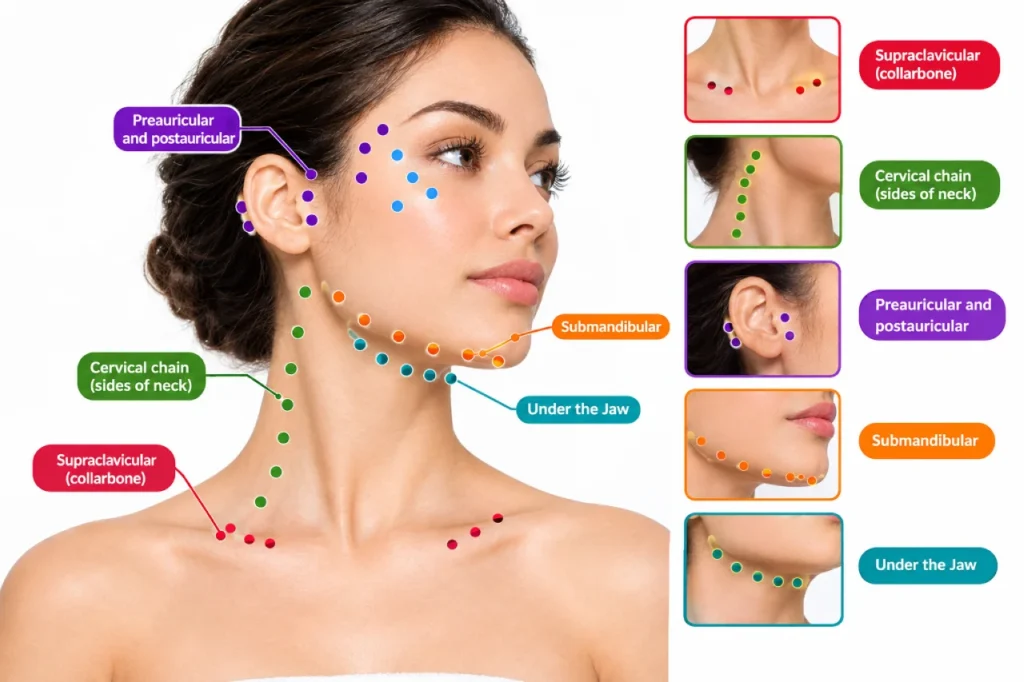
It’s hard to push fluid toward a destination you couldn’t point to, so it’s worth a minute on where the facial lymph nodes actually sit. The map below covers every area this routine touches.
| Area | What drains into it | Roughly where |
|---|---|---|
| Supraclavicular (collarbone) | Everything from the head and neck, eventually | The soft hollow just above the collarbone |
| Cervical chain (sides of neck) | Face, scalp, ears | Down the sides of the neck, beside the long muscle |
| Preauricular and postauricular | Temples, cheeks, forehead, outer eye | In front of and behind each ear |
| Submandibular | Chin, lips, lower cheeks, nose | Under the jawbone, either side of the chin |
Collarbone and Lower Neck
Rest two fingers in the dip above your collarbone, and you’re on it. This is where lymph rejoins your bloodstream, which is why every session starts and ends here.
Sides of the Neck
Turn your head slightly, and you’ll feel a band of muscle running from behind your ear down to your collarbone. The face and neck lymphatic drainage pathway runs alongside it. You aren’t hunting for lumps, just for the line to sweep along.
Around the Ears
Press lightly just in front of your ear opening, then behind your earlobe. These two clusters catch fluid from the upper face, which is why almost every stroke finishes heading toward the ears.
Under the Jaw
Run your fingertips along the underside of your jawbone from chin to ear. These are the busiest lymphatic drainage points on the face, and why the jawline responds faster than most areas.
Which Direction to Massage Your Face for Lymphatic Drainage
The most common mistake in DIY facial lymphatic drainage massage is starting on the face. It feels intuitive, and it works against you. If the neck and collarbone are still congested, you’re pushing fluid toward a closed exit.
Think of it as clearing a drain from the bottom up. You open the collarbone first, then the neck, then work the face in sections, and every facial stroke travels outward toward the ears and then down. Cleveland Clinic describes the goal of a self lymphatic drainage massage the same way: pull the fluid from the face toward the nodes lower down.
The full order for ‘how to do lymphatic drainage massage on face’ looks like this:
- Collarbone
- Sides of the neck
- Chin and jawline
- Cheeks and sides of the nose
- Under-eye area
- Forehead and temples
- Back down the neck to the collarbone
Work through it in that sequence every time, even on the short version.
How Much Pressure to Use for a Lymphatic Facial
Lighter than you think. Considerably lighter.
The test is simple: your fingers and the skin should move together. If your fingertips are sliding across the surface, you’re gliding rather than stretching, and nothing useful is happening underneath. If the skin dimples or reddens, you’ve gone too far the other way. The right weight is close to what a coin feels like resting on your face.
Signs You Are Pressing Too Hard
Your skin will tell you quickly if the pressure has crept up. Watch for these:
- Redness that lingers after the stroke is finished
- Any dragging sensation, particularly around the eyes
- Soreness or tenderness the next day
- Skin that snaps back instead of moving with your fingers
A lymph massage should feel almost boringly gentle. That’s correct, not insufficient.
What You Need for Facial Lymphatic Drainage Massage at Home
Cleanse your face, wash your hands, tie your hair back, and sit somewhere you can rest your elbows.
Choosing an Oil for Slip
Oil stops your fingers from dragging on dry skin. Two or three drops warmed between the palms is plenty. When people ask about the best oil for facial lymphatic drainage massage, these are the reliable options:
- Jojoba, closest to the skin’s own sebum and fine for most skin types
- Squalane, light and non-greasy, a safe default if you’re unsure
- Grapeseed, very light and non-comedogenic, good for oilier skin
- Argan, richer, better if your skin runs dry
Skip anything heavily fragranced, and let it settle for thirty seconds before you begin.
Hands, Gua Sha, or a Lymphatic Massage Tool
Your hands are the tool. They read tension and adjust pressure in a way no stone can. A gua sha stone or a facial lymphatic massager can extend the routine, and a chilled roller feels good on a puffy morning, but neither is required. If you own one, use it after the hand sequence, not instead of it.
The Step-by-Step Lymph Drainage Facial Massage
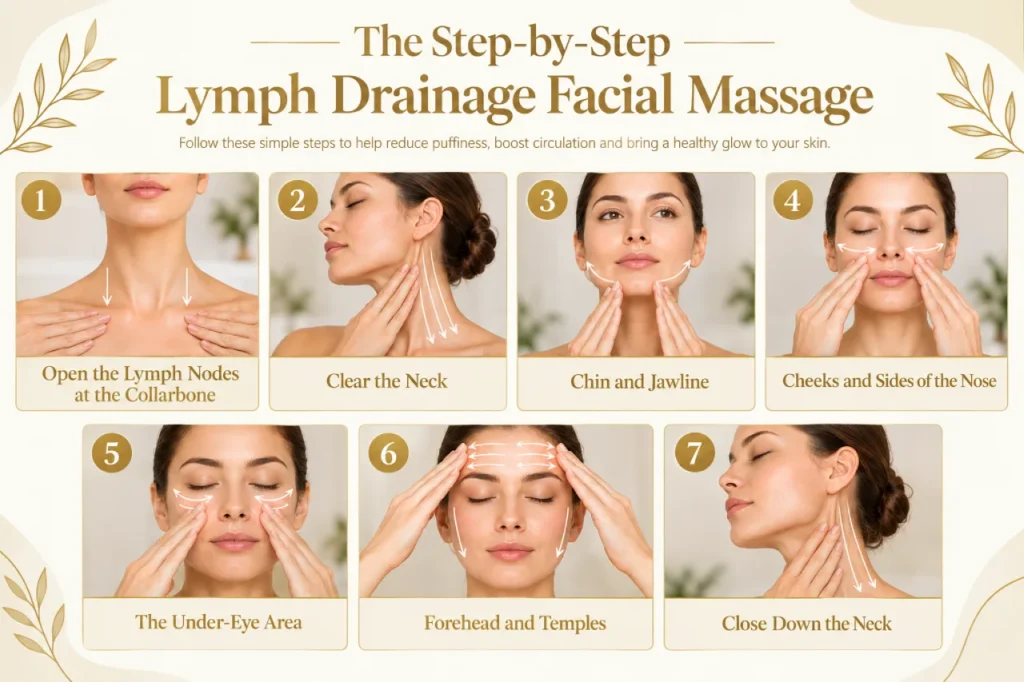
Each step gives you the starting point, the direction, and the repetitions. Keep the pressure feather-light and breathe slowly while you work. These are the core facial lymphatic drainage massage techniques, in order.
Step 1: Open the Lymph Nodes at the Collarbone
Place your fingertips flat in the hollow above your collarbone, one hand on each side. Press gently downward and release, in a slow pumping rhythm rather than a rub. Ten repetitions. Nothing else should move.
Step 2: Clear the Neck
Place flat fingers high on the side of your neck, just below the ear. Sweep downward to the collarbone in one long, slow stroke. Seven to ten times each side, then repeat down the back of the neck from the base of the skull.
Step 3: Chin and Jawline
Start with your index and middle fingers on either side of your chin, tucked slightly under the jawbone. Sweep outward along the jaw toward your ears, pausing lightly in front of the earlobe. Seven to ten repetitions. This is the section that makes the most visible difference for anyone working on a lymphatic drainage massage for the jawline, so give it extra passes if you have time.
Step 4: Cheeks and Sides of the Nose
Place your middle fingers on either side of your nostrils, in the crease running down toward the mouth. Sweep out across the cheek toward the ear, following the cheekbone. Seven to ten repetitions each side.
If you’re congested, this same area doubles as facial lymphatic drainage for sinuses. Slow the movement down, add small circles either side of the bridge of the nose, and keep the pressure light enough that nothing aches.
Step 5: The Under-Eye Area
The skin here is the thinnest on your face, so this is where people most often get it wrong. Use your ring fingers, which naturally apply less force. Start at the inner corner of the eye, resting on the bone rather than the soft tissue, and sweep outward to the temple. Five repetitions.
The rule for ‘how to massage under eyes’ is that you should barely feel it. Never press on the eyeball, and never tug the skin sideways.
Step 6: Forehead and Temples
Place your fingertips in the centre of your forehead above the brows. Sweep outward to the temples, then down in front of the ears. Work upward in rows until you reach the hairline. Seven repetitions per row, three rows.
Step 7: Close Down the Neck
Return to where you started. Sweep from behind the ears down the sides of the neck to the collarbone, ten times, then finish with the same gentle pumping you began with. This is what actually moves everything you’ve gathered.
A Five-Minute Lymphatic Face Massage Routine
On a rushed morning, this condensed version keeps the order intact and drops the repetitions.
| Minute | What to do |
|---|---|
| 1 | Collarbone pumps, then long sweeps down both sides of the neck |
| 2 | Chin and jawline sweeps outward to the ears |
| 3 | Cheek sweeps from the nose out along the cheekbone |
| 4 | Under-eye and forehead, lightest pressure of the routine |
| 5 | Full sweep from behind the ears down to the collarbone |
Don’t skip minute one or five to buy time. Those two bookend the whole thing.
How Often to Do Facial Lymphatic Drainage Yourself
Three or four times a week is a sensible rhythm for general upkeep. Daily is fine too, provided the pressure stays light. Plenty of people fold a short version into their morning routine the way they would cleansing or sunscreen.
If you’re specifically working on a lymphatic drainage massage for a puffy face, daily short sessions for a week or two beat one long session on a Sunday. Consistency does more here than intensity. If your skin starts looking irritated or feeling tender, scale back and lighten the touch.
Mistakes That Stop the Routine Working
Almost every “this doesn’t do anything” complaint traces back to one of these:
- Starting at the face. The neck and collarbone have to be cleared first, every time.
- Too much pressure. The most common issue by a wide margin, and why people end up sore.
- Working in the wrong direction. Strokes travel outward toward the ears, then down. Never up toward the hairline.
- Too little slip. Dry fingers on dry skin drag the tissue instead of stretching it.
- Rushing. Fast strokes turn a lymphatic system face massage into an ordinary face rub.
- Skipping the finish. Ending on the forehead leaves the fluid partway along the route.
When to Stop and See a Professional
Stop if anything hurts, if your skin becomes red or irritated and stays that way, or if you find a lump, a tender node, or swelling on only one side of your face. None of those are things to massage through.
Pause the routine entirely if you have an active skin infection, a fever, an unhealed wound or recent facial procedure, or a cold sore outbreak. Swelling that appears suddenly, worsens, or doesn’t settle over the course of a day belongs with a doctor rather than a self-massage routine.
For anything ongoing, work with someone properly trained. WebMD advises seeking out a certified lymphedema therapist when swelling is persistent or medically related.
Final Thoughts
Two things matter here, and the rest is repetition: work in order, and keep the touch light enough that you’re moving skin rather than pressing into it. Don’t judge it on one attempt either. The shift is gradual, and it usually shows up as a face that looks less tired rather than a face that looks different, so give it a week of mornings before deciding. And if you’d like to feel the right pressure once, from someone who does this daily, before trusting your own hands, a session at Serenity Head Spa isn’t a bad place to start.
Frequently Asked Questions
What is a lymphatic drainage massage?
Very light skin stretching, essentially, done in a direction that moves fluid toward the lymph nodes to be filtered and returned to circulation. On the face, people reach for it when they look puffy or heavy around the eyes and jaw.
How do you do lymphatic drainage massage on your face?
Collarbone first, with gentle pumping, then long sweeps down both sides of the neck. Only then do you touch the face, working up from the chin and always stroking out toward the ears. Finish by sweeping back down the neck. Throughout, the pressure should be light enough that your skin travels with your fingers rather than under them.
How do you drain fluid from your face?
How to drain fluid from your face is mostly a question of order: neck and collarbone cleared first, then each section swept outward toward the ears and down. Prevention does more than technique, though. Less salt, a raised pillow, and enough water stop a lot of it pooling overnight.
How do you open the lymph nodes in your face and neck?
How to open lymph nodes in the face actually starts below it. Gentle pumping above the collarbone, then slow sweeps to drain the cervical lymph nodes down each side of the neck. Under a minute, and it always comes first.
How often should you do lymphatic drainage on your face?
Three or four times a week is plenty for most people. If you’re chasing puffiness, short daily sessions are fine, provided the touch stays gentle, and your skin isn’t complaining.
Can you do facial lymphatic drainage at home without any tools?
You can, and hands are the better option anyway. A gua sha stone or roller adds something, but neither reads tension the way your own fingers do.