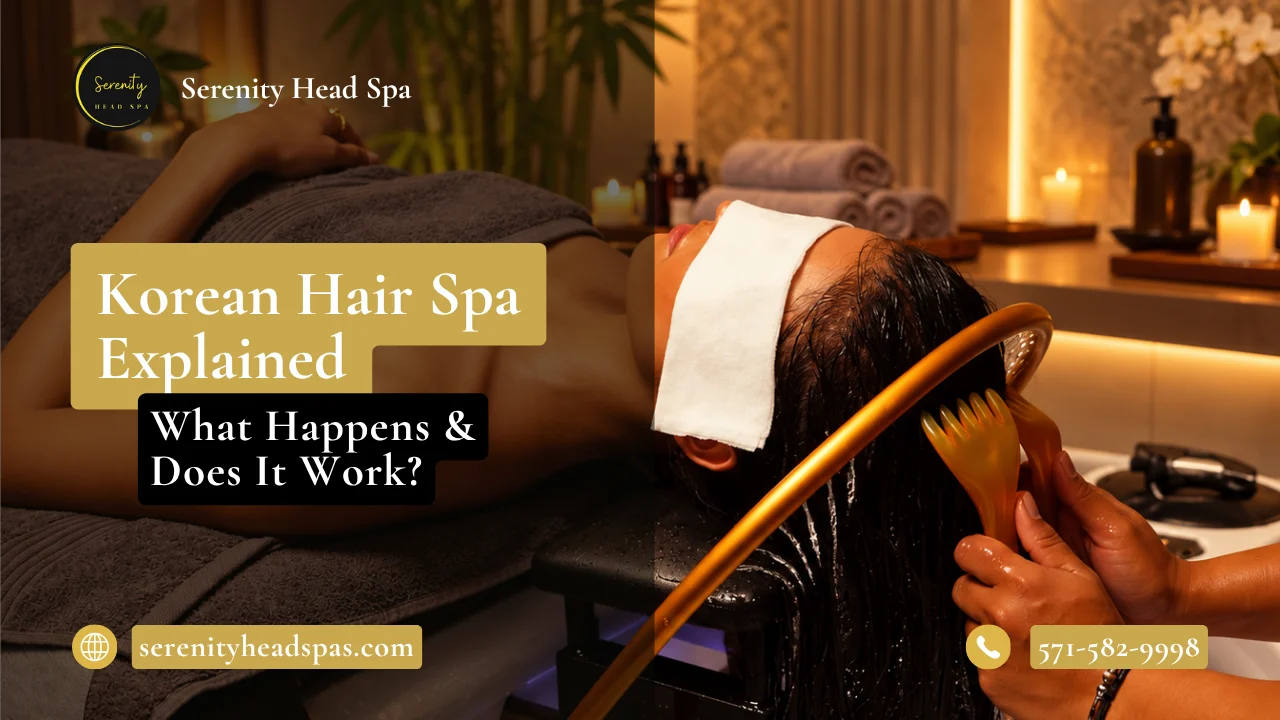
Has a stylist ever studied your scalp before touching your hair? In Seoul, nobody blinks at that. And that scalp-first habit is the backbone of a Korean hair spa. In about an hour, you get washed, scrubbed, masked, and massaged until you nearly nod off. It’s everyday Korean hair care, slowed way down. No official protocol exists, though.
Products and timing change from one salon to the next, and so does the number of steps. Each step, and how it compares with Japanese and head spa services, is below.
What Is a Korean Hair Spa?
There’s no dictionary entry for it. But the name is generally used for a salon hair spa treatment that follows Korean beauty habits. Your scalp and lengths both get attention. No product goes on until the stylist has taken a proper look.
On a Korean salon menu, the word “clinic” sits next to the perms. That’s the conditioning step. So after a rough perm, expect a stylist to suggest one. Sold as a spa, a Korean hair treatment wraps that clinic in scalp work and a massage. Your phone can wait.
Nothing about it is medical, by the way.
What Makes a Korean Hair Spa Different?
In Korean beauty hair care, the scalp is treated like skin, because it is. That idea sells. Between January and November 2025, Korea shipped a record $430 million in hair products abroad, according to Korea International Trade Association data. The biggest buyer? The United States. Five habits make the difference.
A Focus on Scalp and Hair Care
One Korean hair artist on the beauty show Get It Beauty called the top of the head your hair’s trash can. Blunt, but it sticks. In Korean beauty, that spot gets cleaned before the lengths see any product. The skin comparison has limits, though. A research head at the cosmetics maker Kolmar Korea has noted that scalp and facial skin are structurally different. Good scalp care won’t reverse hair loss, either, so it’s worth understanding the facts around scalp massage and hair growth before expecting dramatic results.
Hydration and Nourishment
Moisture alone isn’t enough in a Korean salon. Stylists add protein too, often labeled LPP (low-molecular protein). The bits are tiny and come in a mildly acidic base, near pH 5.5, for hair beaten up by dye or a perm. The payoff is steady hair nourishment: dry ends that finally feel soft.
Multi-Step Treatment Experience
Korean menus love a number. You’ll see 7-step hair treatments and scalp programs that run to 15 or 18 steps, which sounds exhausting until you’re lying down for it. Plenty of salons don’t go that far. But even the shorter menus take their time. Hair conditioning comes in rounds (layer, rinse, layer), and nobody rushes it.
Massage and Relaxation
This is the part you’ll book again for. Some salons even move you to a private room with a chair that reclines almost flat. The scalp massage runs from your hairline to the crown, slow and firm, and with luck it drifts to your neck and shoulders. Want more of it? Serenity’s scalp massage spa offers it as a separate session.
Personalized Hair Care
Your hair texture and history pick the products. One Seoul salon even splits its perm menu by hair condition (normal, dry, or damaged) and throws a basic treatment into the last two. Spa visits work the same way. Hair that’s fine and oily gets a light touch. Bleached lengths get more protein and more time.
What Happens During a Korean Hair Spa?
Give a Korean hair spa treatment at least an hour. You’ll probably switch seats more than once, from a consultation chair to the shampoo bowl to a treatment bed. Expect roughly the order below. Still, some salons fold two steps into one, so read the menu first.
Hair and Scalp Assessment
A lot of sessions open with a scalp camera that can zoom in up to 60 times. Seeing your own scalp that close on a monitor is a little humbling. Then come the questions. When was your last perm? Any bleach in the past year? Some salons scan your scalp again at the end.
Scalp and Hair Cleansing
Two shampoos are normal here, and they’re often different products. The first breaks up oil and styling residue. The second suits your scalp type. And if your scalp goes cold and tingly, blame the menthol in many Korean scalp shampoos.
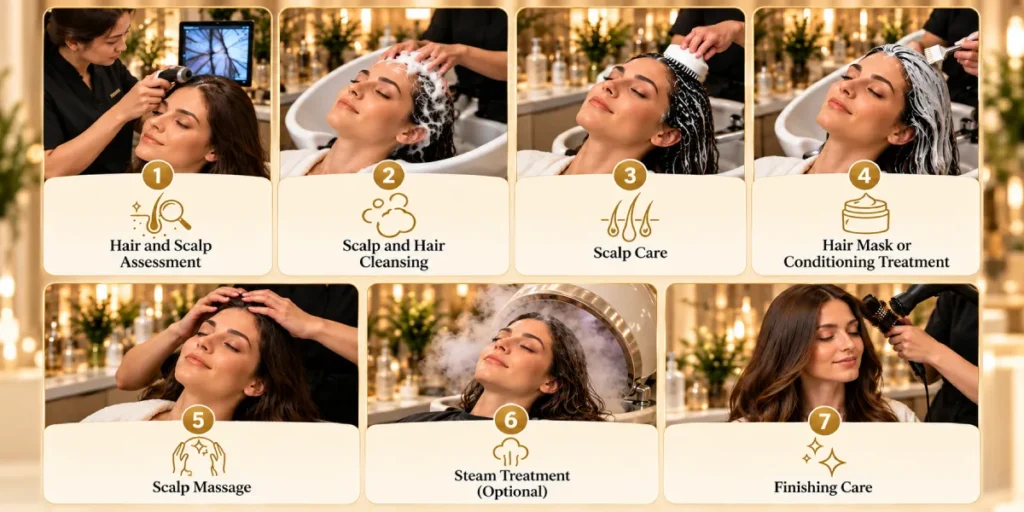
Scalp Care
Here’s where Korean salons really dig in. At many of them, the Korean scalp treatment is built around “scaling,” which sounds dental but means a gel and soft brush that lift off flakes. Sometimes a warm mist comes next, to soften whatever’s left. Then a serum or ampoule is pressed into the scalp. Some salons skip it entirely.
Hair Mask or Conditioning Treatment
Your lengths have waited long enough. The stylist picks a hair mask by condition. Dry ends get moisture. Bleached hair that turns gummy when wet gets protein. This is deep conditioning, so the mask stays put for a while, sometimes under a little heat. Staying awake is optional.
Scalp or Hair Massage
Meanwhile, the therapist’s fingertips get back to your scalp. Most of the pressure goes into your temples and the base of your skull, where laptop days leave their mark. If you’re curious, the benefits of scalp massage go beyond the relaxing feel. Too firm? Say so.
Steam or Warm Treatment
Some places add hair steam here, using a hood that looks like an old-school dryer. Others use a hot towel. Either way, the mask stays warm. Not every salon bothers. Ask first, or look at Serenity’s hair steam service.
Rinse and Finishing Care
Rinse out the mask under lukewarm water. The last splash might be cool, and yes, it’s a shock. Then a wide-tooth comb goes through, ends first. Blow-dry, a drop of serum, and you’re free to go.
What Are the Benefits of a Korean Hair Spa?
Expect cosmetic changes, and expect your fingers to notice them before the mirror does. A couple is obvious by dinnertime. The rest stack up over several visits, so give it a few appointments before you judge. None of it replaces a dermatologist, for the record.
Helps Improve Hair Hydration
Dry hair feels the change first. Run your fingers through it that evening, and the ends probably won’t snag the way they did at breakfast. But the extra hair hydration fades within a few washes.
Makes Hair Feel Softer
Try the ponytail test. Feel the patch where your elastic sits. It gets yanked daily, so it’s usually the roughest, and after a good hair conditioning treatment, it’s the first place you’ll notice a change.
Improves Hair Manageability
Tangles give up faster. Your brush glides instead of catching, so mornings go quicker. And less tugging means fewer broken hairs to sweep off the bathroom floor.
Helps Reduce the Appearance of Frizz
Well-conditioned hair soaks up less water from humid air, so it puffs up less. Heavy rain will still find a few flyaways. Just not as many.
Enhances Smoothness and Shine
Catch your reflection in a sunny window, and you’ll see it. Light bounces off a smooth surface better. But the gloss peaks on day one and fades with each wash.
Supports Scalp Care
With the oil and flakes gone, your scalp feels lighter for a few days. That’s comfort, though, not a cure. Shedding a lot, or stuck with a sore scalp? The American Academy of Dermatology says that calls for a board-certified dermatologist.
Provides a Relaxing Self-Care Experience
Honestly, much of the hair spa experience is lying there doing nothing. Korean even have a word for that hush: goyo. An hour of it, phone out of reach, can do as much for your mood as for your hair.
Who Is a Korean Hair Spa Good For?
In Seoul, a perm is a “pama,” and salons do plenty of them, from soft digital curls to magic straightening. Many Korean-owned salons in the US offer them too. That’s why many Korean treatments are built for hair that’s been through chemicals and heat. Dry hair benefits as well.
Dry Hair
Do your ends feel scratchy against your neck by evening? Start here. Dry hair usually changes fastest. Keep a mask in your shower, and the softness hangs around longer.
Frizzy Hair
Most frizzy hair is simply dry, and it balloons the second the air turns damp. After a smoothing treatment, a muggy July walk to work won’t ruin your style. Each wash undoes a little of it.
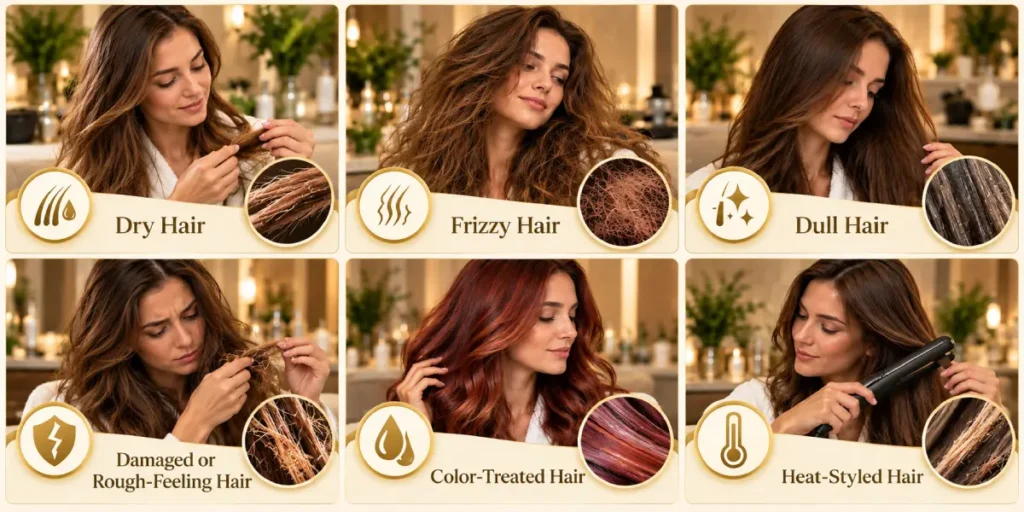
Dull Hair
Dull hair is usually buried under old product. Dry shampoo and hairspray leave a film behind, and the double cleanse strips it off. Want a Korean trick for home? Try a hair vinegar rinse after you shampoo.
Damaged or Rough-Feeling Hair
Bleach and flat irons leave each hair rough, a bit like sandpaper. A protein-heavy mask helps damaged hair feel smoother and snap less. Split ends are another matter, though. Only scissors fix those.
Color-Treated Hair
Dye works by opening the hair’s outer layer, which is partly why color-treated hair feels drier for the first few weeks. So tell your stylist when you last dyed it. A gentle, low-pH formula is easier on fresh color.
Heat-Styled Hair
Flat iron every morning? Your ends have probably noticed, even if you haven’t. A hair spa puts moisture back. Yet the real fix is at home: heat protectant, every single time.
People Looking for a Relaxing Hair-Care Experience
Not every booking is about hair. Some weeks, you just need an hour where no one can reach you. Say so when you arrive, and a good stylist will linger on the scalp and skip the small talk.
Korean Hair Spa vs Regular Hair Spa
“Hair spa” is a catch-all. Almost any conditioning hair treatment with steam or massage can borrow the name. A Korean hair spa is one style within it, with more attention on the scalp and a few more layers. The usual differences:
| Feature | Korean Hair Spa | Regular Hair Spa |
|---|---|---|
| Hair conditioning | Major component | Major component |
| Scalp care | Often emphasized | Varies |
| Massage | May be included | May be included |
| Hydration | Often emphasized | Common |
| Multi-step ritual | Often | Varies |
| Personalization | May be emphasized | Depends on salon |
| Relaxation | Often part of the experience | Depends on service |
Treat the table loosely, since every salon writes its own menu. And if scalp work is the draw, ask if exfoliation is included.
Korean Hair Spa vs Japanese Hair Spa
Both fall under the wider Asian hair spa label, and they share a lot. Where they split, according to one US salon owner who trained in Korea, is the mood: Japanese salons lean into mind-body calm, while Korean ones get more clinical about the scalp.
| Feature | Korean Hair Spa | Japanese Hair Spa |
|---|---|---|
| Inspiration | Korean beauty and hair-care practices | Japanese hair-care and spa practices |
| Hair conditioning | Common focus | Common focus |
| Scalp care | Often incorporated | Often incorporated |
| Massage | May be included | May be included |
| Steam | Depends on provider | Depends on provider |
| Treatment protocol | Varies by salon | Varies by salon |
| Overall experience | Hair and scalp care plus relaxation | Hair and scalp care plus relaxation |
Salons vary a lot under both names, so check the steps before you book. Serenity’s Japanese hair spa guide covers that side in more depth.
Korean Hair Spa vs Korean Head Spa
In Seoul, the two often sit on the same menu. One Cheongdam salon lists a 15-step scalp spa right next to a 7-step hair treatment, as two separate services. And that “waterfall” rinse you’ve probably seen online? It belongs to the scalp side.
| Feature | Korean Hair Spa | Korean Head Spa |
|---|---|---|
| Main emphasis | Hair condition | Scalp and relaxation |
| Conditioning | Strong focus | Often included |
| Scalp cleansing | May be included | Usually more prominent |
| Massage | May be included | Often prominent |
| Hair mask | Common | May be included |
| Steam | Provider-dependent | Provider-dependent |
| Main objective | Hair care and the treatment experience | Scalp care and relaxation |
Names get blurred all the time, so the menu description beats the label. If your scalp is the main concern, Serenity’s head spa services focus on scalp care and massage.
How Often Should You Get a Korean Hair Spa?
There’s no magic number, sorry. Your hair sets the pace, along with the treatment you pick, and no website (this one included) can see your hair. A stylist usually weighs these before suggesting a rhythm:
- How dry your ends feel by midweek
- Any recent color or perm
- How often you use hot tools
- Your hair texture and scalp type
- Which treatment you book
Count how many washes the softness survives. Once your ends start catching again, rebook.
What Should You Do Before and After a Korean Hair Spa?
A little homework before and after makes any salon treatment last longer, and this one’s no exception. None of it is hard. Most of it takes five minutes. Got instructions from your salon? Use those instead. The salon knows its products best.
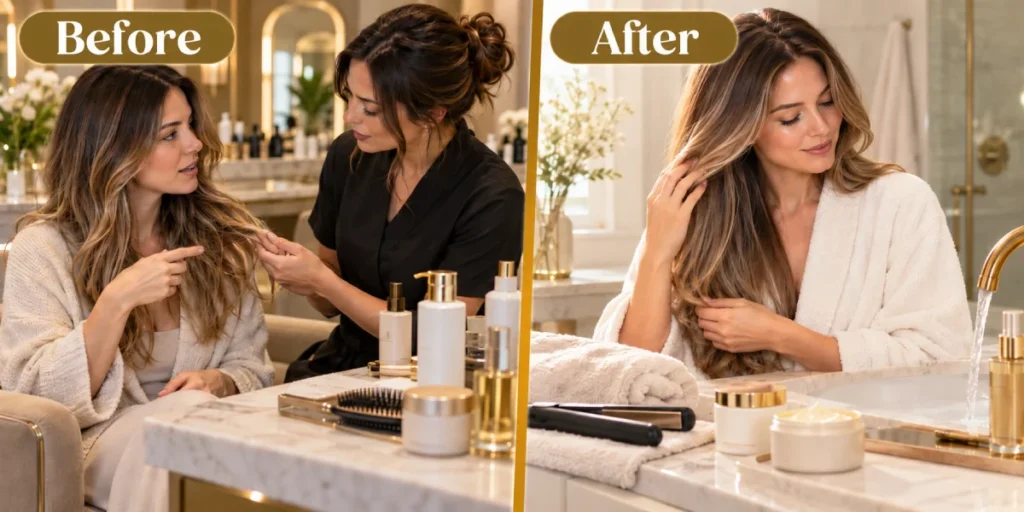
Before Your Appointment
Your stylist can only adjust for what they know. Even a perm from last spring can change how your hair reacts to a mask. So yes, the boring details matter. Bring these along, or mention them when you book:
- Your last color or bleach date, even a rough guess
- The one thing you’d fix first, like frizz
- Anything that’s ever made your scalp itch
- Whatever the salon asks you to do beforehand
After Your Appointment
The first couple of days decide a lot. Wash with very hot water and grab the flat iron the next morning, and you’ve basically undone half your afternoon at the salon. These habits help the softness hold between visits:
- Ask your stylist what to use at home (and snap a photo of the bottles)
- Keep the first few washes gentle
- Give the flat iron a day or two off
- Do a mask once a week, maybe Sunday night
- Read the label on anything you take home
Can You Do a Korean Hair Spa at Home?
Home hair rituals go way back in Korea. Women used to rinse their hair in changpo (sweet flag) water on Dano, an early-summer festival, hoping for shine. And calamus, the same plant, still turns up in a few herbal shampoos. If that botanical approach appeals to you, a herbal head spa takes the idea further. A simple modern version:A simple modern version:
- Work an exfoliating scalp shampoo in with your fingertips
- Comb a mask through your lengths and give it time
- If the mask works better warm, wrap up in a towel fresh out of the dryer
- Rinse with lukewarm water (hot water dries hair out)
- Warm two drops of oil in your palms and smooth them over the ends
It’ll tide you over. Still, nobody at home is checking your scalp under a camera, and that’s where professional hair care starts.
Is Korean Hair Spa Suitable for All Hair Types?
Pretty much, yes. Conditioning works on straight hair, coily hair, and everything in between. Fine strands just need a lighter product than coarse or colored ones. Cosmax, a Korean cosmetics maker, plans products split by curl pattern and scalp condition for the US and South American markets. In a salon chair, the same sorting happens one client at a time.
So if your hair is dry or dull but not falling out or snapping off, a Korean-style session is a low-stress way to win back some softness. Anything that looks medical goes to a dermatologist. When you’re ready to book, Serenity’s hair spa service in Springfield and Rockville is a good place to start.
Frequently Asked Questions About Korean Hair Spa
First booking? These come up again and again, answered in a line or two each. If one hits home, the full section above goes deeper. Nearly all of them come down to the same thing, which is what your own hair needs.
What is a Korean hair spa?
Think of it as a salon hair spa treatment with Korean habits baked in. The scalp gets cleaned and treated first, then your hair gets conditioned.
What happens during a Korean hair spa?
A Korean hair spa treatment usually opens with a scalp check, sometimes on camera. After that come cleansing, scalp care, a mask, and a massage.
What are the benefits of Korean hair spa?
You’ll get softer, more manageable hair and a scalp that feels fresher for a few days. It’s cosmetic, and it builds with regular visits. But hair loss? That’s a job for a dermatologist.
Is Korean hair spa good for dry hair?
Yes. Dry hair usually shows the change fastest. Keep a weekly mask going at home, and the softness sticks around longer.
Is Korean hair spa good for damaged hair?
It helps rough, damaged hair feel smoother and less brittle. Split ends won’t glue back together, though. Those need a trim.
What is the difference between Korean hair spa and Japanese hair spa?
They overlap a lot. Korean-style services usually lean on exfoliation and layered steps, while Japanese-style ones favor calm and massage.
Is Korean hair spa the same as a head spa?
Not quite. A head spa spends most of its time on the scalp, while a hair spa is about your lengths. Menus often mix up the names.
How often should you get a Korean hair spa?
There’s no fixed schedule. It depends on your hair and how often it sees heat or chemicals. When the softness fades, book again.
How long does a Korean hair spa take?
Plan on about an hour. Multi-step versions with scalp scaling can stretch close to two hours, so ask when you book.
Can I get a Korean hair spa if my hair is color-treated?
Yes. Dye leaves hair drier, so colored hair often gets a lot out of it. Just mention your last color date.