Ever googled a foot chart? Looks like a subway map. Colored zones, tiny labels, arrows pointing to your liver. Overwhelming, right? We’ll untangle foot massage pressure points one piece at a time. Where are the real massage spots? What’s the deal with acupressure points? And how much of a foot map should you actually believe? There’s a chart below, an easy way to press, and a list of times to skip it. Fair warning, though. A good foot rub feels great. Fixing your kidneys or curing pain? Not on the menu.
What Are Foot Massage Pressure Points?
Funny thing. People mean two totally different things by this phrase.
Ask a massage therapist about foot massage points, and they’ll point at the spots that feel nice to squish. Ball of the foot. Arch. The cushy bit around your heel. Actual muscle, tendon, and padding you can feel under your thumb. The goal? Feeling good.
Ask a reflexologist, and you’ll get another answer entirely. In acupressure and reflexology, little dots and zones on your soles are said to be wired to faraway body parts. That idea is an old tradition, not something you’d find in an anatomy textbook. Has science backed it up? According to the National Center for Complementary and Integrative Health (NCCIH), that link “has not been proven.”
You might also hear about foot massage trigger points. Those are tender, tight spots in a muscle. That’s a muscular idea, separate from reflexology maps.
Foot Massage Pressure Points Chart
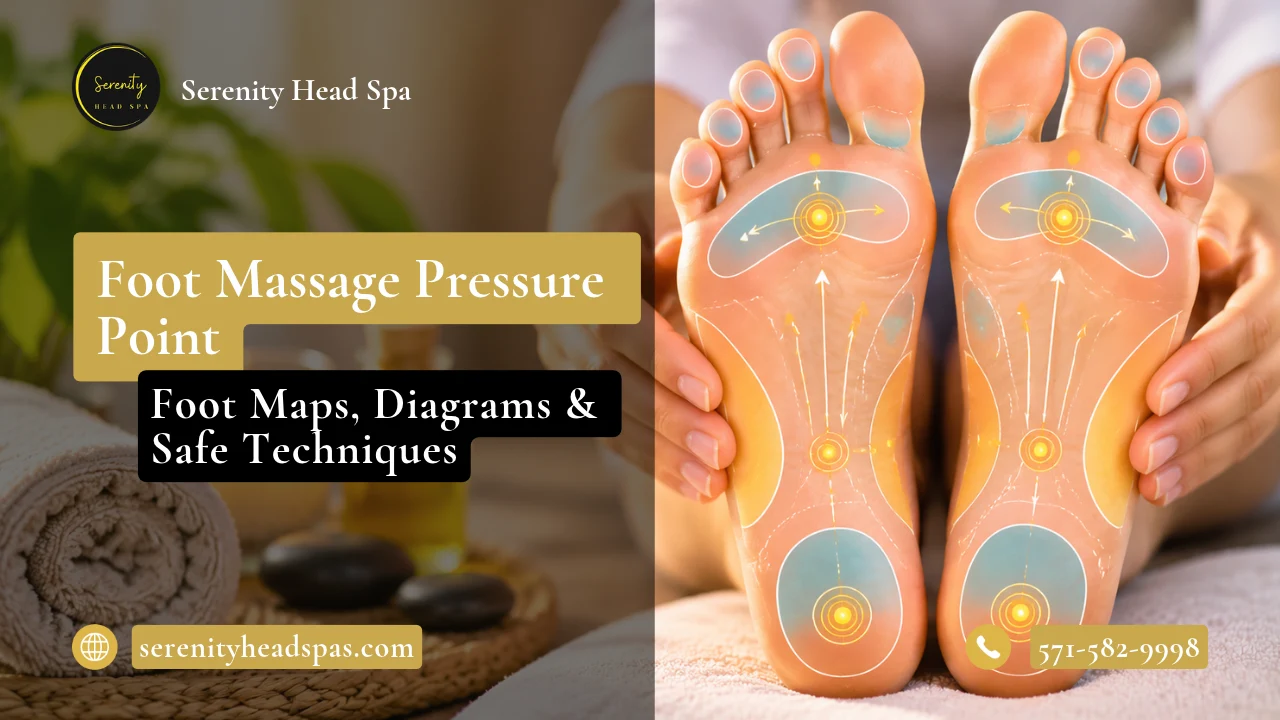
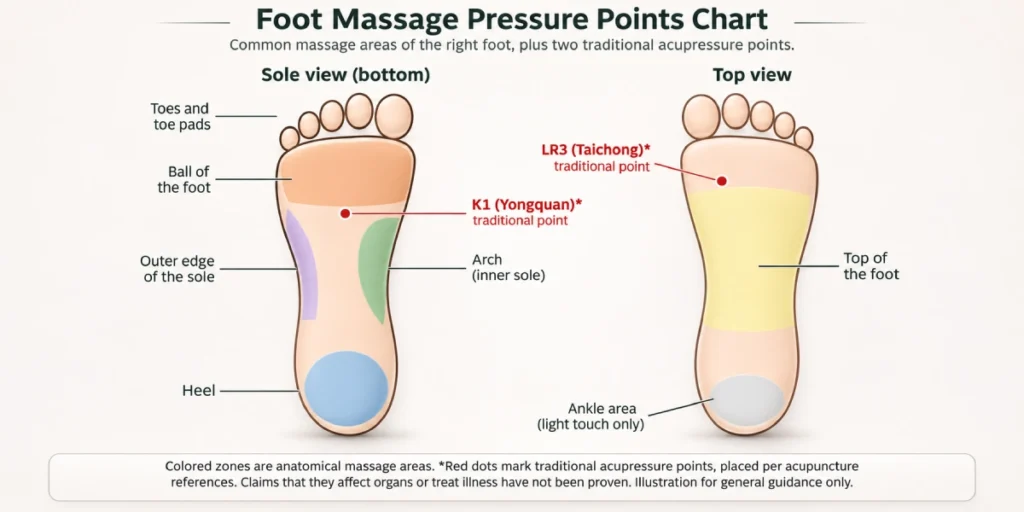
Here’s our foot massage chart. It shows the right foot from the bottom and the top. The colored zones are anatomical massage areas. The two red dots are traditional acupressure points, labeled separately so you don’t confuse them with anatomy.
Treat this foot massage diagram like a sketch, not a GPS. Your arch might sit higher than ours, your heel a bit wider. Searching for female foot massage pressure points? You’ll find plenty of charts. But women’s and men’s feet have the same parts in the same places. Shoe size changes. The map doesn’t.
Common Foot Massage Points and Where to Find Them
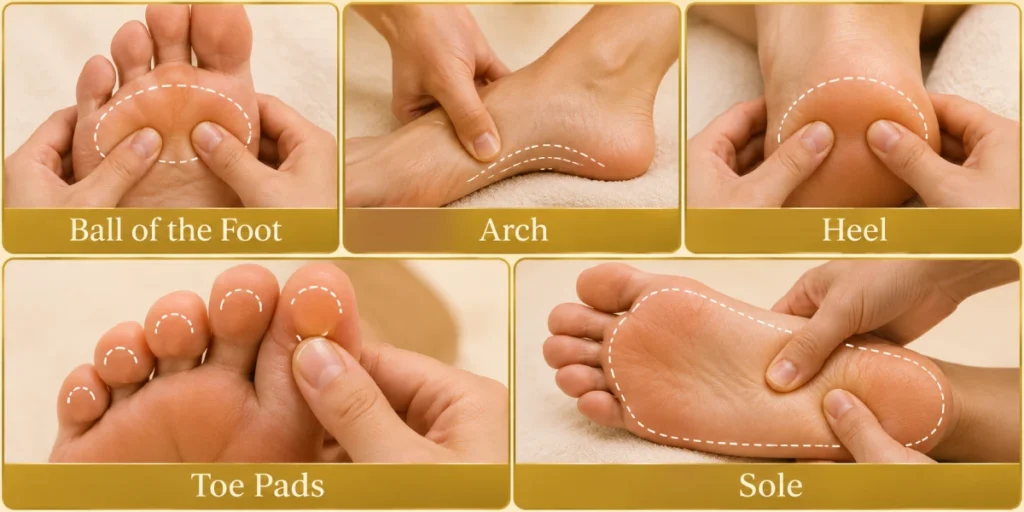
Below are the five big massage areas of the foot. When regular folks say “pressure points,” these are usually what they mean. Each one gets a quick where, how, and don’t. No rushing. If it feels good, you’re doing it right.
Ball of the Foot
Where it is: That cushion right under your toes. It’s what you push off with every step.
How to massage it: Little thumb circles, working across from one side to the other.
Avoid: Leaning on anything that stings or burns.
Arch
Where it is: The scooped-out middle of your sole, closer to the big toe.
How to massage it: Run your thumbs along it slowly, or trace soft circles heel-ward.
Avoid: Jabbing or poking on a sore spot.
Heel
Where it is: The round, tough back end of your sole.
How to massage it: Hold it in your palm and circle the squishy rim with your fingertips.
Avoid: Grinding into bone. Heel pain that won’t leave? Doctor. You can also read our guide to foot massage for plantar fasciitis.
Toe Pads
Where it is: The little cushions on the bottom of each toe.
How to massage it: Pinch a toe gently and rub its pad with your thumb.
Avoid: Yanking, twisting, cracking.
Sole
Where it is: The entire underside, pinky-toe edge included.
How to massage it: Long slides from toes to heel, using your thumbs or the base of your palm.
Avoid: Blisters, scrapes, red or angry skin.
Foot Massage Acupressure Points
Acupressure has its roots in traditional Chinese medicine. It uses finger pressure on the same points used in acupuncture, without needles. Many Chinese foot massage chart designs are based on this tradition. Two famous foot massage acupressure points made it onto our chart. We pulled their locations from published research:
- KI1 (Yongquan)
- LR3 (Taichong)
KI1 (Yongquan) sits on the sole, just behind the ball of the foot. Picture a line from the base of your second and third toes down to your heel. The point is about a third of the way along it, in a small hollow that shows up when you curl your toes. That’s how an acupressure study in BMC Complementary and Alternative Medicine describes its location.
LR3 (Taichong) is on the top of the foot, between the first and second long bones, in the dip just behind where those bones meet the big and second toes. A clinical trial protocol in Trials describes it as “on the dorsum of the foot, between the first and second metatarsal bones.”

We’re sharing locations only. Traditional claims about what these points do for organs or health haven’t been proven, and we don’t make them.
How to Read a Foot Massage Map
Not every foot massage map is the same kind of map. Two kinds exist, and mixing them up causes a lot of confusion.
An anatomical diagram sticks to stuff you can touch. Toes, ball, arch, heel, top. It tells you where you’re pressing. That’s the kind we use above.
Then there’s the reflexology chart, also called a foot massage map of the feet. Picture your soles chopped into colored patches labeled “liver,” “kidney,” and “stomach.” In the reflexology tradition, pressing a zone is believed to affect the matching organ. That’s a belief within the practice, not established anatomy, and NCCIH notes it hasn’t been proven. So if you see a foot massage points chart with organs on it, read it as a traditional map. Don’t use it to self-diagnose.
How to Apply Gentle Pressure to Foot Massage Points
You don’t need a special routine. Want to massage foot pressure points without overdoing it? Try these simple foot massage techniques. Try this:
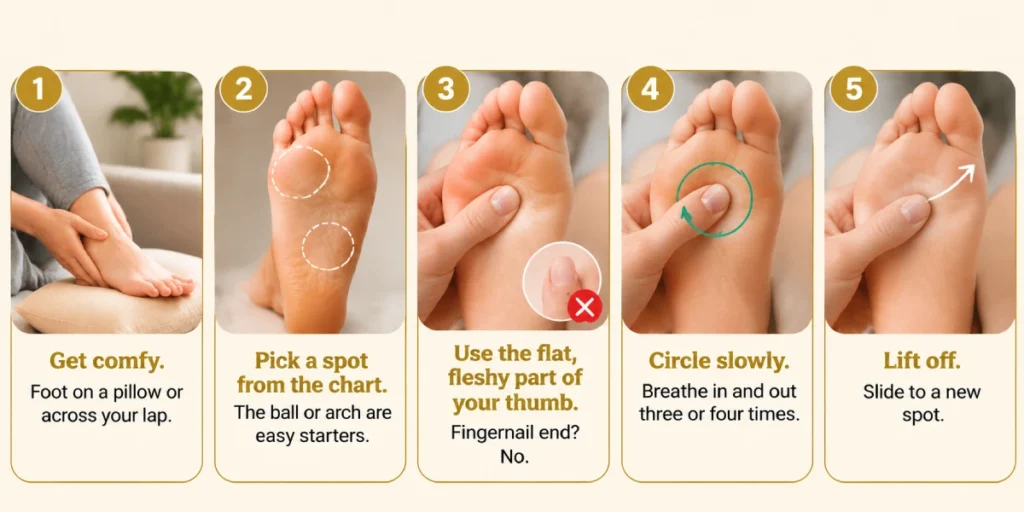
- Get comfy. Foot on a pillow or across your lap.
- Pick a spot from the chart. The ball or arch are easy starters.
- Use the flat, fleshy part of your thumb. Fingernail end? No.
- Circle slowly. Breathe in and out three or four times.
- Lift off. Slide to a new spot.
Firm, not ouchy. A little tenderness is okay. Sharp pain isn’t. Forget the “right” order. There isn’t one. Begin anywhere. Trying foot massage at home? Prop a foot on your other knee and do the same slow circles.
Do Foot Massage Pressure Points Actually Work?
Depends on what you’re hoping for. Pressing pressure points in foot massage tends to feel calming, and plenty of folks say their feet feel better for a bit. These are some of the benefits of foot massage people often look for. Expecting that? Fair.
Claims that pressing a foot point treats an organ, detoxes your body, or cures a disease are a different story. NCCIH says reflexology’s core idea hasn’t been proven, and research on it has been limited and mixed. Foot maps also aren’t diagnostic tools. Tender arch? That’s probably just a tender arch, not a sick liver. Enjoy the rub. Take real health worries to your doctor.
Safety Precautions Before Massaging Pressure Points
For most healthy grown-ups, gentle pressing is pretty safe. NCCIH says serious problems from massage are rare, though some reported cases involved vigorous techniques. Still, a few situations call for care:
- Pain that’s sharp or getting worse
- Reduced feeling in the feet
- Diabetes-related foot problems
- Open wounds or skin infections
- A recent injury
- Puffiness with no clear cause
Sharp pain means back off. Always. Numb feet are tricky, because the person can’t tell you when it’s too hard. Diabetes can damage nerves and take feeling away from the feet, the CDC warns. So if diabetes is part of the picture, talk to a doctor first. Cuts, blisters, infected skin, a fresh sprain, mystery swelling? Leave those spots alone and get them looked at. Tingling, numbness, or pain that’s climbing? Quit right there.
Frequently Asked Questions
Questions still bouncing around? Here’s the quick version.
What Are the Pressure Points on the Feet?
For a regular foot rub, it’s the ball, arch, heel, toe pads, and the rest of the sole. Acupressure adds named dots too. KI1 sits on the bottom, LR3 on top.
Where Are the Pressure Points on the Bottom of the Foot?
Ball up front, arch in the middle on the big-toe side, heel at the back, toe pads at the very tip. Our chart above shows where each one sits.
Do Foot Pressure Points Correspond to Organs?
Reflexology says they do, but NCCIH notes that idea hasn’t been proven. Treat organ labels on foot maps as traditional beliefs, not anatomy.
Are Foot Pressure Points the Same for Everyone?
Same parts, different shapes. Long, wide, high arch, flat. That’s why zones may sit a little differently on your foot than on a chart. Men or women, the layout’s identical.
How Long Should You Massage a Pressure Point?
There’s no set time. Three or four slow breaths per spot works for most people. Feels off? Move on early. Hurts? Stop.
When Should You Avoid Foot Pressure-Point Massage?
Cuts, infections, fresh injuries, mystery puffiness. Skip those. Diabetic or numb feet? Doctor first.
Feet begging for a break? Book a session at Serenity Head Spa in Springfield, VA, or Rockville, MD.
Final Thoughts
Split the anatomy from the folklore, and foot massage pressure points get a lot simpler. Ball, arch, heel, toes, sole. Those are real, and slow thumb circles on them feel great. You can also read about the benefits of foot massage. KI1 and LR3? Tradition. Organ maps? Belief, not proof. Start slow, and you’ll find your favorite spots fast. Go easy, skip anything sore or hurt, and loop in your doctor if diabetes or numbness is involved.
Rather kick back while someone else does it? Try our foot massage in Springfield or Rockville. Your feet will thank you.