A Japanese hair spa is basically a long, unhurried hair appointment with no haircut at the end. First, your hair gets washed properly. A thick hair mask goes on, sometimes under steam. Meanwhile, a slow scalp massage tests how long you can stay awake. Afterward, your hair is soft enough that you’ll keep touching it all afternoon.
Salon menus mix this name up with the Japanese head spa all the time. They’re cousins, really. A hair spa cares most about your strands. A head spa camps out on the scalp. Each step, and how often to book, comes up below.
What Is a Japanese Hair Spa?
On paper, a Japanese hair spa has the same steps as the hair spa at your usual salon. It just lingers a little longer at each one. You’ll sometimes see it listed as an Asian hair spa, since Korean and other East Asian salons work in a similar way. What you’re really paying for is attention, plus a mask that stays on long enough to matter. It’s beauty care, and anything medical belongs with a doctor.
How Is a Japanese Hair Spa Different From a Regular Hair Spa?
Both count as professional hair spa care, but the Japanese take is fussier, in a good way. Your hair and scalp get checked before a single product comes out. The massage is built in from the start. You end up with a more customized hair treatment and a calmer hour. There’s no official rulebook, though. One salon adds steam and exfoliation. Another skips both and spends longer on the mask. Ask what yours includes.
What Makes a Japanese Hair Spa Unique?
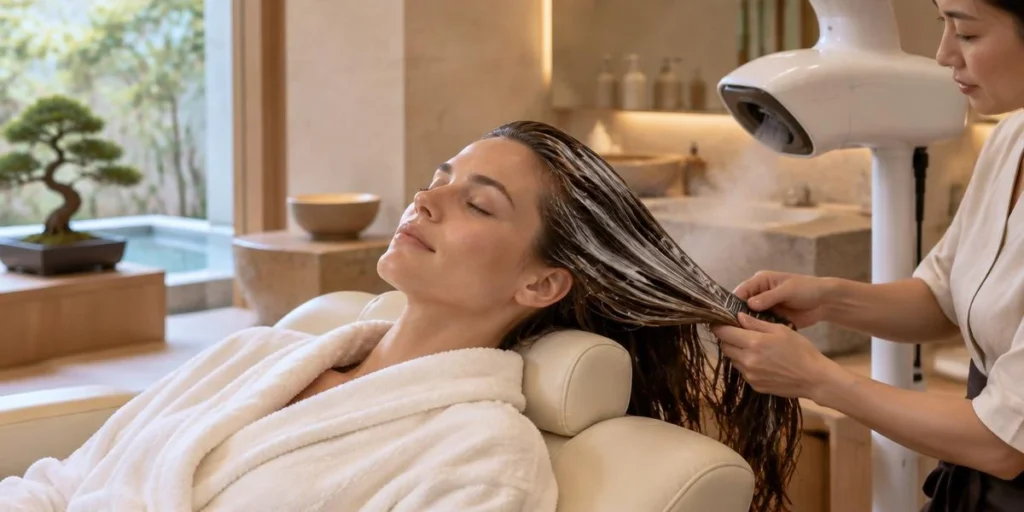
It comes down to patience. Japanese hair care never rushes a step, since each one quietly sets up the next. It shows up in five places.
A Focus on Scalp and Hair Care
Japanese salons tend to treat your scalp like the skin on your face. So scalp care gets real time. It starts with a slow scalp cleansing that lifts the oil and dry shampoo a quick wash leaves behind. The mask needs that step. It can’t soak through product buildup. Bonus: fresher-looking roots for a few days.
Multi-Step Hair Conditioning
Most of the hour goes here, because hair conditioning happens in layers. The deep conditioning layer comes first. A moisture sealer follows it, and a featherweight finish goes on last. Where does the hair mask start? Your ends. That’s the oldest, driest hair you’ve got. The stylist stops short of the roots so fine hair doesn’t go flat.
Massage and Relaxation
You’ll think about this part on the drive home. Somewhere around the second slow pass over your temples, your jaw lets go. Your shoulders drop. Can massage alone regrow hair? AdventHealth says the evidence for that is thin. So enjoy it for the relaxation. That’s plenty.
Attention to Hair Texture and Condition
No two heads get the same jar. Your hair texture matters most. Fine hair collapses under a mask that coarse hair would soak up in minutes. Then there’s hair condition, which also affects what your stylist chooses.
Bleached last month? Use a flat iron every morning? Each of those answers changes what your stylist mixes into the bowl. That’s what makes it a customized hair treatment.
Japanese-Inspired Ingredients and Formulas
Ingredient lists on Japanese hair care products repeat the same few names. Every salon picks its own mix. You’ll see these most often:
- Tsubaki (camellia) oil, a hair staple in Japan for generations
- Rice bran or rice water
- Amino acids and plant extracts, added mainly for hair nourishment
Allergic to any of these? Say so first.
What Happens During a Japanese Hair Spa?
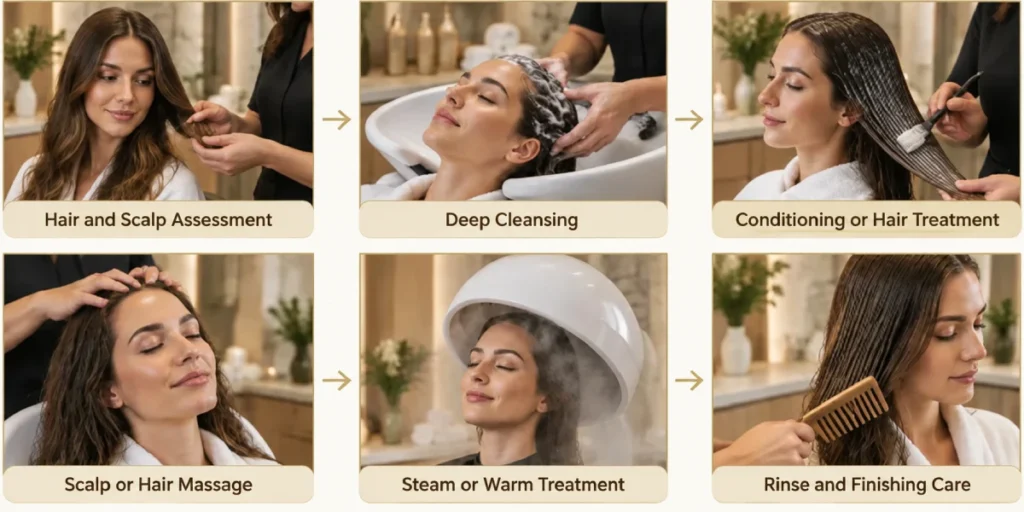
A Japanese hair spa treatment in Tokyo and one in Northern Virginia won’t match step for step. Most follow some version of this order, and the whole thing plays out as one unhurried salon treatment.
Hair and Scalp Assessment
Nothing gets wet yet. Your stylist starts with a hair and scalp analysis, checking for dry, snapping strands and other signs that may affect the treatment. Some Japanese-style salons go further, with a tiny camera that puts your scalp up on a screen, pores and all. That close look comes from Japanese scalp treatment practice. Expect questions about color and heat tools. Your answers decide which products get used.
Deep Cleansing
Next comes the basin. Most stylists cleanse twice. The first round is for oil and old styling product. The second gets the hair properly clean. Some Japanese salons rinse with carbonated water here. It leaves a faint fizz on the scalp. Thorough scalp cleansing lays the groundwork, since a mask can’t do much on hair that’s still coated.
Conditioning or Hair Treatment
On goes the hair conditioning treatment. It’s worked through in sections, ends first. Dry lengths get the heaviest moisturizer. Frizz gets something smoothing. Bleached lengths get a protein-leaning repair hair mask. Then it sits. Lighter formulas need only a few minutes. A richer deep conditioning treatment stays on longer, usually under heat.
Scalp or Hair Massage
The scalp massage starts at your hairline and moves back to the crown in slow circles. Every so often, the therapist stops and holds a pressure point. Nails stay out of it. It’s the quietest stretch of the appointment. Serenity offers it on its own as a scalp massage spa session, too.
Steam or Warm Treatment
Many salons add hair steam at this point. A steamer or hood sends warm mist over the mask. That damp heat helps the treatment get further in. Smaller salons may use a hot towel instead. If a dedicated hair steam treatment is the part you want, ask when you book, or look at Serenity’s hair steam service.
Rinse and Finishing Care
The rinse runs lukewarm. Some Japanese salons switch to a micro-bubble showerhead for it. Wet hair snaps easily, so detangling starts at the bottom with a wide-tooth comb and inches upward. Then it’s a blow-dry, and you’re done.
What to Expect After the Treatment
Your fingers notice first. Slide them down a strand that evening, and the ends probably won’t catch like they did that morning. Within a few days, you may notice the flat iron staying in the drawer. One visit gives you a preview. The real verdict takes a few.
What Are the Benefits of a Japanese Hair Spa?
One session feels good. The bigger changes pile up quietly, visit after visit. Booked regularly, it works like a hair hydration treatment you never forget to do. Every benefit below grows out of that steady hair nourishment. None of it is medical.
Deep Hydration for Dry Hair
Dry hair is where you’ll notice the change first. A hair’s outer scales form the cuticle, its protective layer, per an article in the National Library of Medicine archive. Heat and dye lift them, letting water out. Under warmth, a rich mask restores hair hydration and settles the scales.
Softer and More Manageable Hair
Each visit leaves the lengths a little softer. Your comb catches less on the way down, and mornings get a few minutes shorter. That’s hair manageability in real life.
Improved Shine and Smoothness
Shine comes down to light. A flat cuticle reflects it cleanly, so regularly conditioned hair holds its ‘hair shine’ and ‘hair smoothness’ for a few washes. Dermatology Times draws the same link in its piece on preventing breakage.
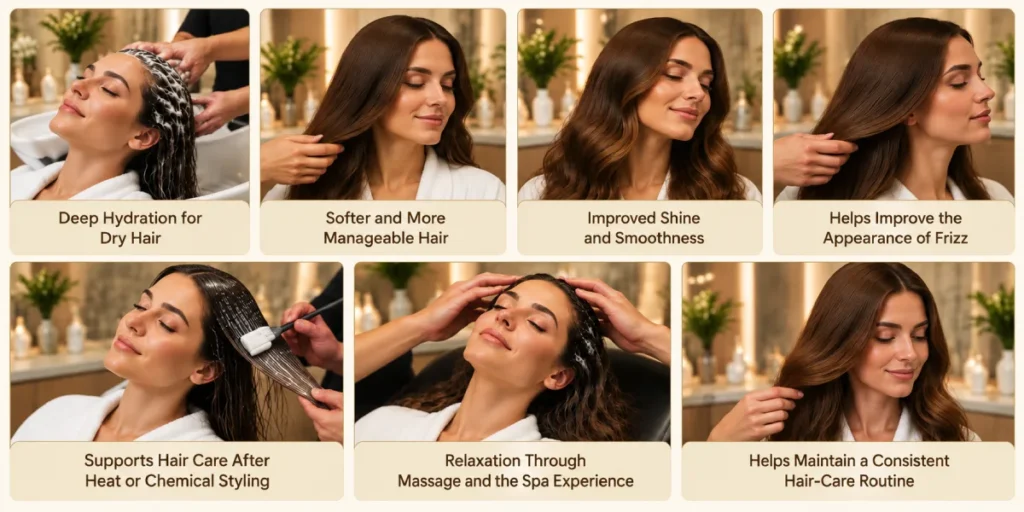
Helps Improve the Appearance of Frizz
Frizz starts when dry strands soak up moisture from the air unevenly. A sealed cuticle keeps most of that water out. The effect is temporary. A sticky July afternoon in the DC area will still raise a few flyaways.
Supports Hair Care After Heat or Chemical Styling
Every bleach session takes something out of the hair. So does every pass of a flat iron. A conditioning session puts back what it can. It won’t undo years of heat. It does slow the slide.
Relaxation Through Massage and the Spa Experience
Then there’s the hour itself. Your phone stays in your bag, and nobody needs anything from you. That quiet hair-care ritual, with the massage at its center, can end up being the part you miss most between visits.
Helps Maintain a Consistent Hair-Care Routine
A tub of mask by the sink is easy to forget. A booked slot with your stylist is not. It gives your hair-care routine a fixed date on the calendar, which is half the battle with any upkeep.
Who Is a Japanese Hair Spa Good For?
Most different hair types can benefit from one, although the treatment works best as a damaged hair treatment for hair that’s healthy underneath and tired on top, or as upkeep for hair that just runs dry. What changes from head to head is the mask.
Dry or Dehydrated Hair
Pinch a strand near the bottom and slide your fingers off the end. Papery tips with normal-feeling roots put you in this group. Dehydrated hair takes a mask in fast, which is why your first visit tends to show the biggest change. Swim laps? Pool chlorine strips the hair’s natural oil.
Frizzy or Rough Hair
Tsuyu, Japan’s early-summer rainy season, has a reputation for wrecking frizzy hair. Damp air sneaks into rough, dry strands and puffs them up. Sealing the cuticle with a mask helps the halo lie down. You won’t be humidity-proof, but the fight gets easier between visits.
Dull-Looking Hair
Dull hair is often just coated hair, dimmed by hard-water minerals and leftover dry shampoo. So a Japanese salon spends extra time on the cleanse, lifting that layer off first. A mask then smooths the cuticle underneath. Of everything here, shine is usually the quickest thing to come back.
Heat-Styled Hair
Daily heat leaves its mark slowly. Heat-damaged hair gets crisp at the ends, almost like straw, and styles stop holding the way they used to. A standing moisture top-up can’t reverse that. It does slow the damage between trims.
Color-Treated Hair
Bleach and permanent dye both pry the hair open to do their work, and it doesn’t fully close again. Moisture slips out through the gaps, which is how color-treated hair goes from silky at the salon to rough by the weekend. A mask between color visits helps it stay soft. Give your new shade about a week to settle before you book.
Chemically Treated Hair
Perms and relaxers change your hair’s shape with chemicals. Japanese straightening, or thermal reconditioning, does it with chemicals plus a hot iron. Either way, moisture takes a hit. A spa visit puts some slip back into chemically treated hair. After a perm, wait a few days. Go in too early, and a heavy mask could loosen a curl that hasn’t fully set.
People Looking for a Relaxing Hair-Care Experience
Not every reason to book is about the hair. Some Japanese salons market the head spa almost as a nap. Booking a hair spa purely for the quiet and a slow scalp massage is fine, too. The softer hair just tags along.
When a Hair Spa May Not Be Enough
A conditioning treatment works on the hair you can see. It can’t reach a problem that starts at the follicle. No mask, Japanese or otherwise, changes that. These belong with a board-certified dermatologist:
- More hair than usual in the shower drain
- Sudden breakage with no new product or tool to blame
- An itchy or sore scalp that won’t settle
- Flakes that return even with a medicated shampoo
- Any scalp change you can’t explain
The American Academy of Dermatology advises seeing a board-certified dermatologist when better habits don’t turn things around, especially with thinning. Keep the hair spa for the hair you have, and book a doctor for anything that looks medical.
Japanese Hair Spa vs Regular Hair Spa
Underneath the names, both services are mostly about conditioning, so expect plenty of overlap on the menu. The Japanese version just builds more ritual around it, with extra hands-on time and products picked for your hair specifically. The table lines them up:
| Feature | Japanese Hair Spa | Regular Hair Spa |
|---|---|---|
| Hair conditioning | Central | Central |
| Hydration | Strong focus | Usually included |
| Scalp care | Often included | Varies |
| Massage | Often included | May be included |
| Steam | May be included | Depends on salon |
| Treatment ritual | More structured | Varies |
| Relaxation component | Often emphasized | Depends on service |
| Customization | Usually emphasized | Varies by provider |
Menus bend these rules all the time. Check the description on yours before booking.
Japanese Hair Spa vs Japanese Head Spa
In Japan, most salons simply say “head spa.” American menus borrow both names loosely. The difference shows in where the time goes. With a hair spa, most of it goes into your lengths. A Japanese head spa barely leaves the scalp care. Side by side:
| Feature | Japanese Hair Spa | Japanese Head Spa |
|---|---|---|
| Primary emphasis | Hair condition and appearance | Scalp health and relaxation |
| Hair conditioning | Strong focus | Often included |
| Scalp cleansing | Often included | Major component |
| Scalp massage | May be included | Usually prominent |
| Steam | May be included | Often included |
| Hair masks | Common | Common |
| Relaxation | Important | Major part of the experience |
| Best suited to | Dry, dull, or rough-looking hair | Scalp care and relaxation goals |
Start with your complaint. Dry, dull lengths point to a hair spa. A scalp that’s greasy by lunch, or one that feels tight after a long week, is head spa territory. Want to see how Serenity pairs scalp care with massage? The head spa services page has the details.
Japanese Hair Spa vs Hair Treatment
Ask a Japanese stylist for a “treatment,” and you’ll usually get conditioning. Try that in a US salon, and you might walk out with a bond builder or keratin. A hair spa treatment rolls several steps into one appointment. A targeted treatment chases one named problem. Here’s where they split:
| Feature | Hair Spa Treatment | Targeted Hair Treatment |
|---|---|---|
| Main focus | Conditioning and appearance | One specific concern |
| Typical goal | Moisture, softness, shine | Depends on the treatment |
| Approach | General, multi-step care | Targeted |
| Examples | Cleanse, mask, massage, steam | Protein, bond repair, keratin, smoothing |
| Best starting point | Dry, dull, rough-feeling hair | A specific, persistent issue |
Pick by goal. For general upkeep on tired hair, a hair spa fits well. For one stubborn problem, a treatment built for it will do more. Many menus let you add a targeted step onto the spa itself.
How Often Should You Get a Japanese Hair Spa?
Your schedule will probably differ from your friend’s, even with the same haircut. A few things decide the timing:
- Overall hair condition and dryness
- Color or chemical processing
- How often you use heat
- Your hair texture
- Scalp condition and how fast it gets oily
- The specific products and treatment used
A session every few weeks is a sensible opening rhythm. Book a little sooner if dryness returns within two weeks. If your hair still feels soft a month later, stretch the gap. By the third visit or so, you and your stylist will have it figured out.
What Should You Do Before and After a Japanese Hair Spa?
Most of what helps takes two minutes or less. Here’s what to keep in mind on both ends of the appointment.
Before Your Appointment
Japanese salons open with what they call counseling, a short consultation that sometimes comes with a written form. You’ll get more out of it if you arrive with these covered:
- When you last had color, bleach, a relaxer, or keratin
- Any allergy, or a product that once made your scalp sting
- The one thing you’d change about your hair if you could
- Clean hair with no heavy styling product, if the salon asks for it
After Your Appointment
Try not to undo the treatment the moment you get home:
- Follow the product recommendations your stylist gives you
- Go easy on heat styling for a day or two
- Use a suitable conditioner or mask between visits
- Skip clarifying shampoo for the first few washes
- Finish damp hair with a leave-in, or what Japanese brands call an “out bath” treatment
Can You Do a Japanese Hair Spa at Home?
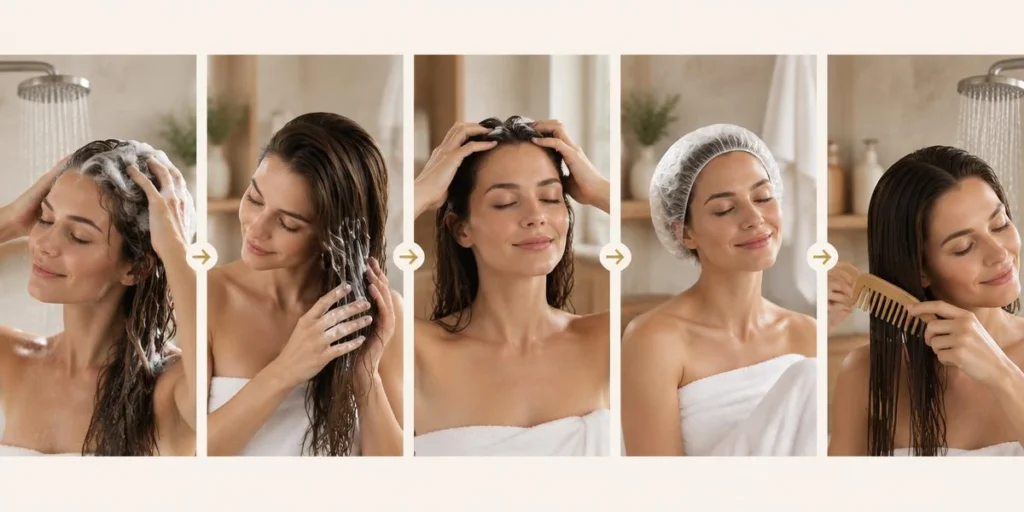
A Japanese hair care routine at home is the stripped-down version, minus the steamer and the trained hands. It does help the results last between visits. For the scalp part, pick up a soft silicone brush from a J-beauty shop or online. A towel warmed in the dryer stands in for the steamer. The routine:
- Wash with a gentle shampoo
- Work a mask through the mid-lengths and ends
- Massage your scalp with your fingertips for a few minutes
- Cover with a shower cap and warm towel if the product calls for heat
- Rinse with lukewarm water and detangle with a wide-tooth comb
What a bathroom can’t give you is a mask chosen after someone has studied your hair up close. Use both. Each one makes the other go further.
Is a Japanese Hair Spa Worth Trying?
A professional hair spa is worth a try if your hair is healthy underneath and just tired on top. It tends to suit you if:
- Your hair feels dry, rough, or hard to manage
- Shine fades by midweek
- You use heat styling most mornings
- Your hair is color-treated or chemically treated
- You want a structured, relaxing session
You may need something different if your main concern is unexplained hair loss, a persistent scalp condition, significant breakage, or hair that needs a specialized repair or smoothing treatment. Those call for a dermatologist or a targeted service first.
If it’s the right fit, a good Japanese hair spa leaves you with softer, glossier hair and an hour you didn’t spend answering email.
Match the treatment to your hair, keep a weekly mask going at home, and send anything that looks medical to a dermatologist. When you’re ready for a session built around your own hair, start with Serenity’s hair spa service. Serenity runs its Springfield and Rockville locations as a true Japanese hair treatment salon, so book a session near you at serenityheadspas.com.
Frequently Asked Questions
What is a Japanese hair spa?
It’s a salon hair-care session built around your hair’s condition, not just a quick wash. A Japanese hair spa usually pairs a deep cleanse with a conditioning hair mask, a scalp massage, and often steam. The goal is cosmetic: softer, smoother, easier-to-handle hair.
What does a Japanese hair spa do?
Most of it, you can feel the same day. A hair hydration treatment under warmth smooths the cuticle, so hair looks shinier and combs through with fewer snags. It won’t regrow hair or fix anything medical. Think upkeep, not repair.
Is Japanese hair spa good for dry hair?
Yes. Dry hair is where the change shows up fastest. A rich mask puts moisture back, and a few sessions keep that papery feeling at bay longer between washes. Ends that have already split still need a trim.
Is Japanese hair spa good for damaged hair?
It helps hair that’s rough from bleach, color, or heat feel softer and look smoother. A damaged hair treatment like this conditions what’s still there. It can’t glue broken strands back together, though. For that, scissors do more than any jar.
How long does a Japanese hair spa take?
Around an hour at most salons. A shorter version runs closer to 45 minutes. The longer, layered rituals, with extra steam or a longer massage, can stretch past 90 minutes. Ask when you book so you can plan the afternoon.
How often should you get a Japanese hair spa?
Every few weeks is a fair starting point. Color, bleach, and daily heat push it sooner. Hair that air-dries and rarely meets a flat iron can wait longer. Watch how your hair feels between visits and adjust from there.
What is the difference between a Japanese hair spa and a Japanese head spa?
Watch where the hands spend their time. A hair spa works the lengths, conditioning for feel and shine. A Japanese head spa stays up on the scalp, cleansing and massaging. Many menus blur the two names, so check what’s actually included before you book.
Is a Japanese hair spa suitable for all hair types?
Most hair can take one. What changes is the formula. Fine hair gets a lighter mask so it doesn’t go flat. Coarse or coily hair can handle something richer. A customized hair treatment matched to your hair texture matters more than the label on the menu.
Does a Japanese hair spa include steam?
Often, but not always. Many salons add hair steam to help the mask sink in, while others use a warm towel or skip heat entirely. It depends on the service and the salon. If steam is the part you want, ask before you book.
Can I get a Japanese hair spa if my hair is color-treated?
Yes, and color-treated hair tends to welcome it. Color can leave the lengths porous and quick to dry out. A mask between appointments keeps them softer. Tell your stylist about any recent color or bleach so they can pick the right products and timing.