For most people, there’s no single correct answer to how often should you do scalp massage. If your goal is a healthier scalp or simple relaxation, a few short sessions a week are enough. If you’re hoping for thicker hair, the limited research points to daily, gentle massage, though the evidence remains modest.
This guide walks through what you need to decide your own routine: how often to massage, how long each session should last, what the hair-growth studies actually show, whether daily is safe, how scalp massagers compare, how oil fits in, what your scalp type calls for, and when to stop.
How Often Should You Massage Your Scalp?
It depends on why you’re doing it in the first place. Scalp care, relaxation, and hair-growth hopes each want a slightly different rhythm, and your scalp type tweaks the number on top of that. The table sets out a sensible scalp massage frequency for each goal. Treat it as a starting point, nothing stricter.
| Goal | Practical starting point |
|---|---|
| General scalp care | 3 to 4 times a week |
| Relaxation | 2 to 3 times a week |
| Hair-growth interest | Daily, based on limited research |
| Oily scalp | Less frequent, lighter pressure |
| Dry scalp | Gentle massage, a little more frequent is fine |
| Scalp massager with shampoo | A few times a week |
| Oil massage | 1 to 2 times a week is usually enough |
These are starting points, not fixed rules. Your scalp usually lets you know within a week or two whether a routine suits it.
How Often Should You Do Scalp Massage for Hair Growth?
If thicker hair is the reason you’re here, the goalpost moves a bit. Every study that looked at scalp massage for hair growth used daily, steady sessions, so daily is the frequency with any evidence behind it. The catch: daily has to mean gentle. And more is not the same as better.
What the Research Actually Tested
Most of the buzz traces back to one 2016 paper in the journal Eplasty. Nine healthy men in Japan massaged one side of the scalp with a device, four minutes a day, every day, for 24 weeks. The massaged side came out thicker, strand width going from roughly 0.085 mm to 0.092 mm. Small numbers, but a measurable change. Two things to keep in mind: these men weren’t losing hair to begin with, and what grew was thicker strands, not more of them or faster ones.
What the Larger Scalp-Massage Survey Found
For a wider view, there’s a 2019 survey in Dermatology and Therapy. About 340 people with self-assessed pattern hair loss were asked about their own massage habits. Most put in 11 to 20 minutes a day and stuck with it for around seven months. Roughly 69 percent felt their hair loss had either settled down or reversed a little. Now the caveats. People graded themselves, nobody ran a control group, and the whole thing came from a source that also sells a massage guide. It’s encouraging. It just doesn’t prove much by itself.
Does More Massage Mean More Hair?
No. This is where a lot of blogs get carried away. Neither study showed that extra minutes bought extra hair. What seemed to help was sticking with it week after week, not grinding away in long, hard sessions. And to be clear, massage isn’t a fix for diagnosed hair loss. If you’re shedding more than usual, book a dermatologist. A longer massage won’t cover for that.
Can You Massage Your Scalp Every Day?
So is it okay to massage your scalp every day? For most people, yes. The word doing the heavy lifting there is gentle. Daily doesn’t give you a license to dig in with your nails or scrub until the roots tug. Four or five light minutes with your fingertips, every day, is a perfectly sensible habit. Ten rough minutes every day is how scalps get sore.
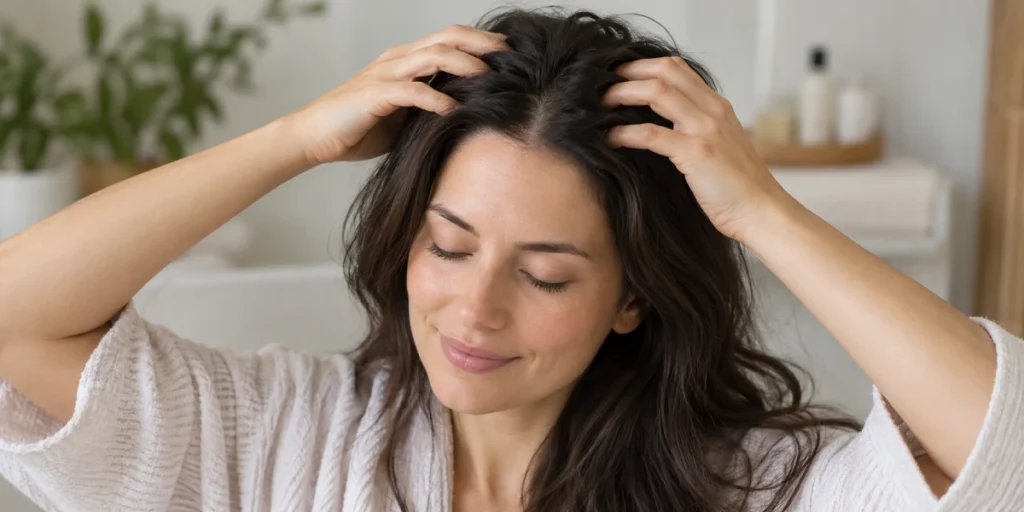
Whether daily suits you comes down to a few things. Pressure first: firm enough to shift the skin, never enough to hurt. Keep each session short, because short and frequent beats long and infrequent. Friction is the other thing to watch. Dry hair tangles, so a damp scalp or a little oil smooths the way. If you feel strands pulling, change what your hands are doing. And if your scalp turns tender, flaky, or sore, that’s your cue to do fewer sessions, not pile on more.
How Long Should You Massage Your Scalp?
Length depends on the goal again, and shorter is usually smarter than you’d think.
For General Scalp Care
Three to five minutes does the job. You’re loosening buildup and giving the skin a bit of movement, not running a marathon.
For Relaxation
Here you can slow right down. Ten or twenty minutes feels lovely and genuinely helps you unwind, which is pretty much the whole idea behind the scalp massage sessions at Serenity Head Spa. Let comfort set the length, not the clock.
For Hair-Growth Interest
The thickness study used all of four minutes a day. The survey crowd did more, closer to 11 to 20 minutes. So how long should you massage your scalp for hair growth? Anywhere in that four-to-twenty-minute range, done regularly, is as far as the evidence will take you. Stretch it to 40 minutes, and you’re on your own, since nothing backs that up.
How Often Should You Use a Scalp Massager?
A handheld or silicone scalp massager isn’t quite the same as your own fingers. It saves your hands, it holds its grip in the shower, and yes, it feels great. The downside is feedback. You feel less through it, so it’s easier to overdo without realizing it.
A few times a week suits most people, usually while you’re shampooing. Got a silicone brush? Let it glide, don’t scrub. Longer hair tangles, so go carefully, and ease off the second your scalp feels raw. One thing to get straight: a massager is a convenience, not a stronger dose of anything. There’s no prize for using it harder or longer than your fingers would go.
Does Scalp Massage Actually Help Hair Growth?
So, does it work? Cautiously, yes. The fair read on whether scalp massage helps hair growth is a hopeful maybe: some benefit, within limits, and more for thickness than for length.
What the Evidence Suggests
The controlled study measured thicker strands after months of daily effort. In the survey, most people felt their hair loss had slowed or turned around. Stack the two together, and you’ve got a fair case that steady, gentle massage does something for some people. The likely mechanism is physical: stretching the skin around each follicle and giving the cells underneath a nudge.
What the Evidence Does Not Prove
What it doesn’t prove is that massage regrows hair the way minoxidil or finasteride do. Those big, confident percentages came from a survey people filled in themselves, not a controlled trial. And no large, properly run study has shown massage reversing pattern baldness. Go in hopeful, not convinced.
Hair Thickness vs. Hair Growth Rate
This distinction slips past most people. The evidence is a lot friendlier to thicker hair than to faster-growing hair. The 2016 study clocked strand thickness climbing. It did not catch hair sprouting any quicker, or in bigger numbers. So when a bottle promises massage will speed up your growth, that promise is running ahead of the proof.
Does a Scalp Massager Help Hair Growth?
Marketing loves to smudge this line. True, the thickness study used a device. But nothing in the research says a handheld massager beats bare fingers for growth. The useful part is the gentle mechanical pressure, and your fingertips hand that over for free. A scalp massager for hair growth mainly helps you stick with the habit. That’s its honest pitch. Your hands can do the work either way.
Scalp Massage Frequency by Scalp Type
Your scalp type sways the comfortable number more than any hair goal does. Read the notes below as tweaks to that three-to-four-a-week baseline.
Normal Scalp
The easy one. Three to four times a week suits most normal scalps, and daily is fine if it feels good.
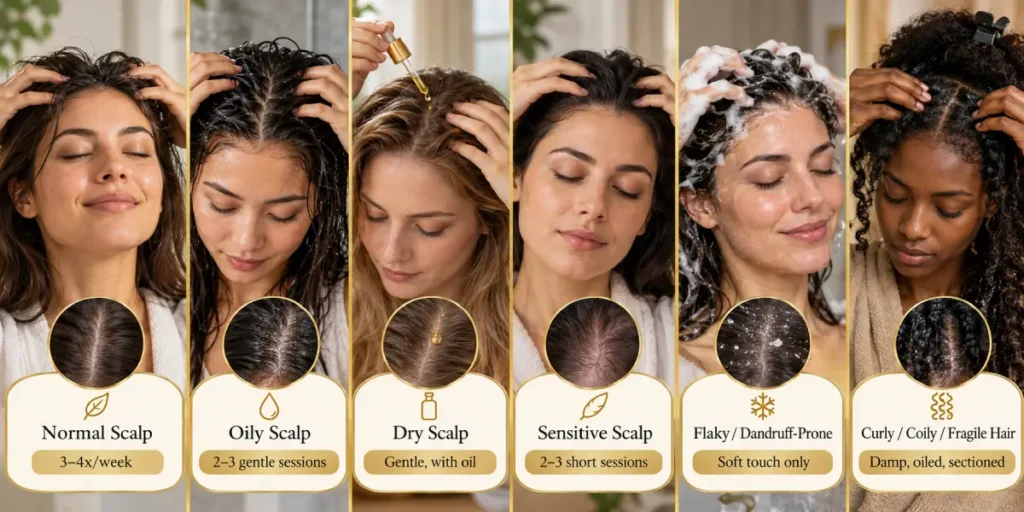
Oily Scalp
Lighter touch, fewer sessions. Rubbing hard every day just drags oil down the strands and has you looking greasy sooner. Two or three gentle sessions a week, timed near wash day, usually sits better.
Dry Scalp
Gentle works well here, and a bit of oil takes the edge off the friction dry skin hates. Scrubbing is the thing to avoid, since dry scalps flake and get irritated fast.
Sensitive Scalp
Err on the side of less. If yours reddens or stings in a hurry, cap it at two or three short, light sessions a week, and stop the moment it feels sore.
Flaky or Dandruff-Prone Scalp
Massage can loosen flakes, which is handy. Too much friction can also wind up an itchy, inflamed scalp, which isn’t. Keep it soft, lean on a medicated shampoo if that’s part of your routine, and keep your nails out of it.
Curly, Coily, or Fragile Hair
Here, it’s the hair that’s delicate, more than the scalp. Work on damp, oiled hair so nothing tangles or snaps; go section by section, and move the skin underneath rather than dragging through the strands.
How Often Should You Massage Your Scalp With Oil?
Oil changes the math a little. You don’t have to oil your scalp every single time you massage, and oiling your scalp too much just leaves a film that dulls the hair. Once or twice a week, worked in with a gentle massage, covers most people. Fine or oily hair sits at the low end of that. Thick or dry hair can take a touch more.
The question of scalp massage before or after oil is a whole topic of its own. Quick version: if you’ve massaged with oil, you can usually skip a separate dry session that day. Our guide to scalp massage for glowing skin and healthy hair explores its broader beauty benefits.
How to Massage Your Scalp Without Causing Irritation or Hair Breakage
Most of the trouble comes down to technique. A few basics for how to massage your scalp without leaving it sore or snapping strands:
Use Your Fingertips, Not Nails
Let the pads of your fingers do everything. Nails scratch skin and snag hair, and that’s exactly how irritation and breakage start.
Move the Scalp Instead of Rubbing the Hair
The goal is to glide the skin over the skull in small circles. If your hand is just sliding over the hair itself, all you’re making is friction and tangles.
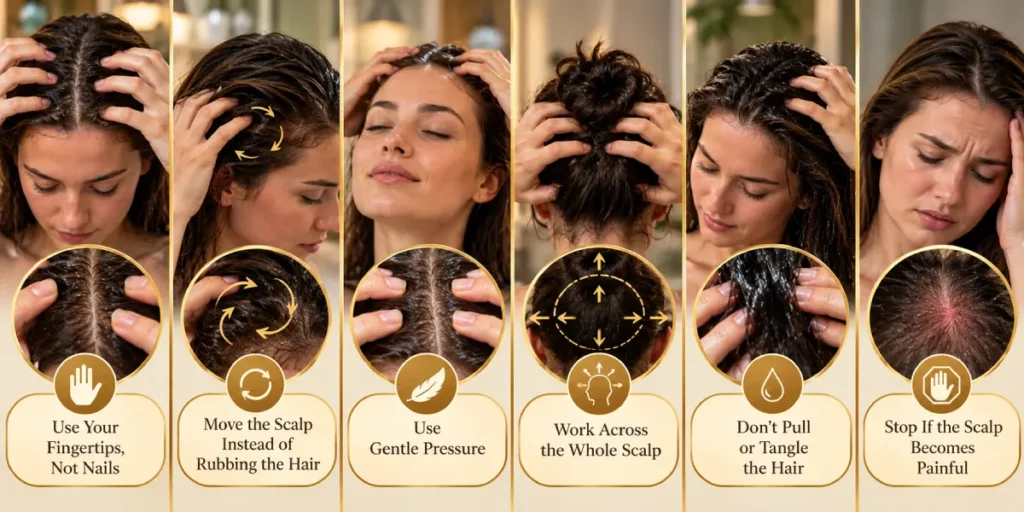
Use Gentle Pressure
Firm enough to feel, soft enough that it never hurts. Pain isn’t a badge of a good massage.
Work Across the Whole Scalp
Cover the lot: front, sides, crown, and back, not only the spot that feels nice. A minute or two per area is plenty.
Don’t Pull or Tangle the Hair
Keep the whole thing snag-free. With dry, textured, or long hair, add a little oil, or massage straight after a shower, so the strands slide instead of catching.
Stop If the Scalp Becomes Painful
Soreness during or after means ease off rather than push on. You want to finish relaxed, not wincing.
Signs You’re Massaging Your Scalp Too Often or Too Aggressively
Yes, there’s such a thing as too much, and your scalp and your hairbrush will both tell you. Back off, or take a few days away, if you spot:
- Soreness or tenderness that hangs around after you’ve finished
- Redness, or a warm, irritated feeling
- More hairs than usual in the brush
- Itching that’s getting worse, not calming down
- A scalp that’s touchy to even light contact
And remember, frequency is only half of it. Two light minutes a day is kinder to your scalp than a hard ten-minute scrub twice a week. How you do it counts just as much as how many times.
When Should You Avoid Scalp Massage?
It’s low risk overall, but a handful of situations mean leaving your scalp be and checking with a professional first. Skip the massage when you’ve got:
- A scalp that’s painful, inflamed, or infected
- Open cuts, sores, or a healing wound
- A rash, a bad skin-condition flare, or any active irritation
- Hair shedding that’s sudden, heavy, or out of nowhere
- A recent scalp procedure your provider told you to rest
Hair loss or scalp symptoms that stick around deserve a dermatologist’s eyes. Massage is a good habit to keep. It’s no stand-in for an actual diagnosis.
A Simple Weekly Scalp Massage Schedule
If you’d rather just be handed a plan, grab the routine that fits your goal and adjust as you go.
Beginner Routine
Five minutes, three days a week. Fingertips, light pressure, skip the oil. An easy way to learn how your scalp reacts.
General Scalp-Care Routine
Five to ten minutes, three or four days a week. Loosens buildup and keeps things comfortable up top. If you’d like professional care for both your hair and scalp, explore our hair spa service.
Hair-Thinning Interest
A gentle few minutes, daily, roughly matching what the thickness study tested. Light and consistent is the whole game. Just keep your expectations honest: the research doesn’t promise a result or a magic number. If the thinning keeps up, loop in a dermatologist.
Relaxation Routine
Ten to twenty minutes, a couple of evenings a week. Slow, unhurried, oil if you want it. This one’s for your head as much as your hair.
Oil Massage Routine
Once or twice a week. Warm a little oil, work it in slowly, and leave it to sit before you wash. No need to tack on a dry massage the same day. For a relaxing professional option, you can also explore our herbal head spa.
How Long Does It Take to See Results?
It depends on which result you mean. Relaxation is immediate. You’ll feel calmer by the time the first proper session ends. Scalp comfort isn’t far behind, somewhere between a few days and a couple of weeks, once buildup clears and the skin settles into the routine.
Thickness is the slow burner. The 2016 study took its measurements at 24 weeks, not 24 days. If thicker hair is the aim, think months of steady effort, and keep your hopes a long way under whatever a 30-second clip online is selling. Hair just doesn’t move at that speed.
Frequently Asked Questions
What Does Massaging Your Scalp Do?
Several things at the same time. It brings more blood flow to the skin, lifts away flakes and product buildup, spreads your own oils down the hair, and simply feels good. The thickness angle is the shakiest of the lot, so treat the scalp-care and stress-relief side as the safe wins.
What Are the Benefits of Scalp and Head Massage?
The surest benefits of scalp massage are a cleaner, more comfortable scalp and a genuine drop in tension, which is exactly why a proper head massage feels so good after a rough day. There might be a small thickness payoff if you stay consistent, though that part’s less settled. For plenty of people, the relaxation on its own is reason enough.
How Many Times Should I Massage My Scalp?
General upkeep, three to four times a week is a safe default. Relaxation, go by mood. Hair-growth hopes: daily and gentle is the one with evidence behind it. Then let your scalp type push the number up or down.
Is It Okay to Massage Your Scalp Every Day?
For most people, yes, provided it stays gentle and short. When daily goes wrong, it’s the pressure and the nails doing it, not the daily habit. Touchy, flaky, or sore scalp? Drop back to a few times a week.
Can You Massage Your Scalp Too Much?
You can. The tell-tale signs are tenderness, redness, extra shedding, and an itch that’s getting worse. Nine times out of ten, it’s heavy pressure, not too many sessions. Ease off the pressure first. If that doesn’t fix it, spread the sessions further apart.
How Often Should You Grease (Oil) Your Scalp?
Once or twice a week does the job for most. Daily oiling tends to pile up and weigh the hair down without much to show for it. Fine or oily hair prefers the lighter end. Dry or thick hair can handle a bit more.
Does a Scalp Massager Work Better Than Your Fingers?
For results, no. It’s gentler on your hands and handy in the shower, sure, but your fingertips give the same soft pressure the studies relied on. Go with whichever one keeps you doing it.
Final Thoughts
There’s no one schedule for everyone, and that’s genuinely okay. A few gentle sessions a week keeps most scalps content. Daily is safe as long as you keep it light. For thicker hair, the evidence points to short, steady, daily massage over months, held together with sensible hopes rather than big promises. In the end, your scalp is the best judge, so let it set the pace. And if you’d like a calmer scalp and a routine built around your own hair, the team at Serenity Head Spa is happy to help, with gentle, hands-on head spa sessions at a speed that suits you.